Automatic inline de-flashing of injection-molded work pieces
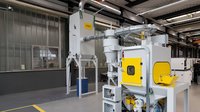
For quality reasons a globally leading manufacturer of garden implements and motorized tools established a plastic injection molding system for engine parts at its production facility in the United States. The geometrically complex work pieces are de-flashed in a swing chamber blast machine, model RWS 1200-I4-SAT2, supplied by Rösler. This system, completely integrated into the manufacturing flow, allows fully automatic de-flashing of the work pieces and their transfer to the assembly line at the precise output speed of the injection molding machine.
In forest and garden maintenance as well as landscaping and construction the tools and implements of this company, headquartered in Germany, enjoy a first-class reputation around the world. They are produced at various locations on several continents. To maintain the excellent international quality reputation of the motorized tools, purchased components must meet extremely high standards regarding dimensional accuracy and functionality. Two injection-molded thermoset engine components, supplied by external suppliers for the US manufacturing facility, did not consistently meet the specified quality standards. For this reason, the company decided to make these components in-house, including the removal of flashes created during the molding operation. Since in Europe the company cooperates with suppliers, who offer excellent solutions from Rösler for the “de-flashing of plastic components”, the engineers responsible for this project contacted the Rösler US subsidiary in Battle Creek (Michigan).
Challenging quality and cycle time requirements
The specifications of the garden implement manufacturer were quite comprehensive and detailed, demanding full automation of the entire manufacturing operation. Among other things, this included supplying the injection molding machine with threaded bolts, the actual molding operation, the de-flashing and cleaning of the components - containing through-holes - at a cycle time of 60 seconds (per two parts) and, finally, the transfer of the de-flashed components to the assembly line. Based on processing trials, conducted by the sales and process management team at Rösler, an equipment concept was developed around the proven swing chamber machine RWS 1200. This system was specifically designed for gentle de-flashing of thermoset and highly filled thermoplastic components.
Consistent and efficient processing with minimal non-productive idle production times
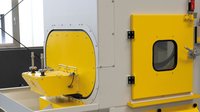
The compact RWS 1200-I4-SAT2 system has two chambers, each containing two rotating satellite stations with integrated fixtures for holding the work pieces measuring about 55 x 80 x 80 mm (L x W x H). This clever dual chamber design ensures that while in one chamber the work pieces are de-flashed, finished and raw work pieces are unloaded, respectively, loaded in the other chamber. This practically eliminates any non-productive idle production times.
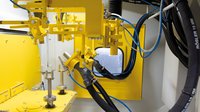
A robot handles the precise placement of the components on the workpiece-specific holding fixtures, which were designed and built by Rösler in close cooperation with the customer. In the blast chamber two (2) pairs of injection blast nozzles, positioned at the upper and lower end of a vertical linear shuttle unit, are accelerating and precisely throwing the specially developed, non-abrasive blast media onto the rotating work pieces. Since the rotational positioning of the satellite stations is extremely precise, robotic handling of non-round, random-shaped components at the load station poses no problem whatsoever.
In addition, the precise rotational positioning, in combination with the vertical linear unit and the multi-step process control, allows a temporary stop of the work piece rotation. This ensures that difficult-to-reach surface areas like drilled holes can be reliably de-flashed. Depending on the work piece shape, each individual nozzle can be turned on or off during the various process steps, which guarantees a highly efficient shot blasting operation. Upon completion of the de-flashing process residual blast media and dust are removed with a compressed air blow-off system.
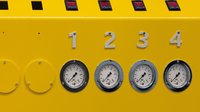
All process steps, such as picking up the work pieces for their precise placement on the holding fixtures, the settings of the linear shuttle unit, the defined rotation stops, the turning on/off of individual nozzles and the blow-off cycles, are stored in workpiece-specific programs and visually displayed on the operating screen of the PLC. This fulfilled another customer requirement.
Shorter processing time yields substantial cost savings
The new RWS 1200-I4-SAT2 de-flashing system works so effectively that the cycle time for de-flashing 2 work pieces is about 15 seconds below the 60 seconds specified by the customer. During this “saved” time the media and compressed air consumption is practically zero. This represents significant savings in resource and energy usage and reduces the overall operational costs.
Excellent media quality and ATEX compliant dust collection
The highly effective blast media recycling and cleaning system with air extraction from the blast chamber and screening unit, combined with automatic media replenishment, guarantees consistently high media quality for the de-flashing operation. The special Rösler antistatic additive, injected into the blast chamber and automatically replenished, significantly reduces electrostatic charges and, thus, minimizes adhesion of dust and media on the finished work pieces. Finally, the shot blast machine is equipped with an ATEX compliant dust collection system.