Surface Finishing of Orthopedic Implants – Critical for Function, Service Life, and Patient Safety | Part 1
, Michael Striebe - Torna alla panoramica
Orthopedic implants are among the most demanding products in medical technology. They permanently replace damaged joints, perform complex biomechanical functions, and must simultaneously meet the highest requirements in terms of biocompatibility, wear behavior, and dimensional accuracy. Accordingly, precisely coordinated surface finishing throughout the entire manufacturing process is of great importance, as the functional performance of an implant is largely determined by its surface. This is exactly where automated mass finishing and blasting processes come into play.
Different Functional Areas Require Different Surface Conditions
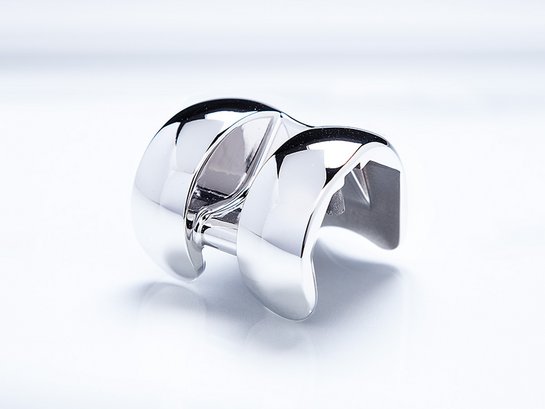
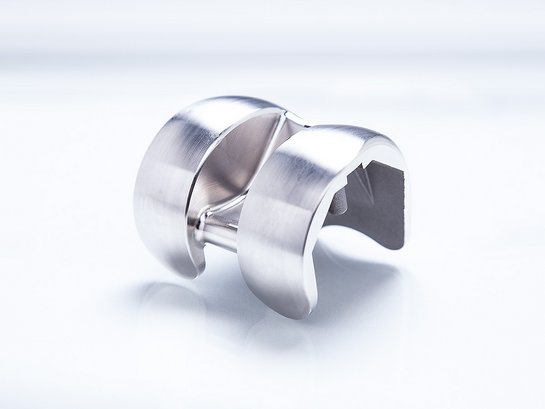

Implants for joint reconstruction often have to meet opposing requirements at the same time. While moving contact surfaces must be extremely smooth, bone-facing areas require deliberately structured surfaces.
For example, the articulating surface of the femoral component of a knee implant requires a high-gloss polished finish in order to permanently minimize friction and wear. In contrast, a defined surface roughness is required on the bone-facing backside to promote osseointegration and ensure stable long-term fixation.
This functional differentiation makes it clear that orthopedic implants typically undergo several coordinated processing steps. These may include preparatory, function-specific, and service-life-enhancing processes such as:
- Cleaning
- Deburring and edge radiusing
- Smoothing
- Targeted surface texturing
- Preparation for coatings
- High-gloss polishing
- Blasting processes for the introduction of compressive residual stresses
Only the interaction of these processes ensures permanently reliable implant performance.
Precision and Biocompatibility as Key Requirements
Implants for joint reconstruction are subject to particularly stringent quality requirements. They must reliably withstand millions of motion cycles while remaining in the human body for as long as possible—ideally permanently.
Among the most important characteristics are:
- High biocompatibility
- Corrosion resistance to body fluids
- Low friction at contact surfaces
- High mechanical strength
- Precise dimensional accuracy
- Fully radiused edges
- Optimal conditions for osseointegration
In particular, the combination of dimensional accuracy and defined surface structure determines whether an implant will function reliably over the long term.
Materials Determine the Requirements for Processing
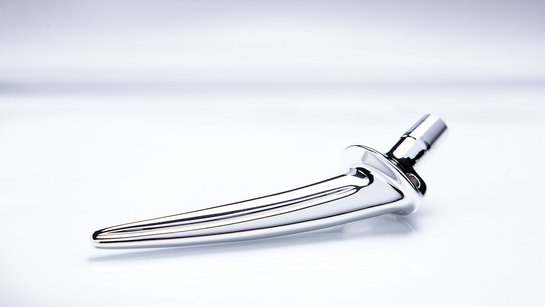
In addition to geometry, the material used plays a decisive role in selecting suitable processing technologies. The most commonly used materials today include:
- Titanium and titanium alloys
- Cobalt-chromium alloys
- Highly cross-linked polyethylene (e.g., UHMWPE)
- Ceramics
These materials are characterized by high strength, excellent corrosion resistance, and very good biocompatibility. At the same time, however, they also place high demands on reproducible processing technologies.
Functional coatings are also frequently used, such as PVD coatings based on titanium nitride or zirconium nitride. These reduce friction, increase wear resistance, and improve the long-term stability of implants. Plasma coatings, on the other hand, are specifically used to support osseointegration. A prerequisite for this is precisely defined surface pre-structuring through blasting processes.
Surface Quality Determines Service Life and Comfort
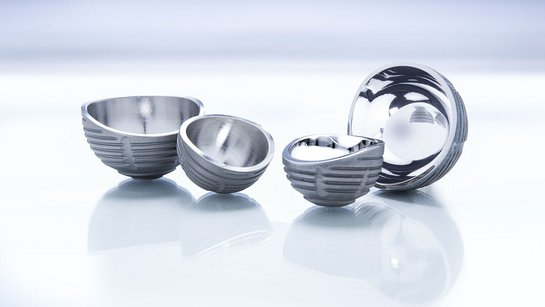
The functional performance of an implant results from the precise coordination of all components within a joint system. Even minimal deviations in surface quality can have long-term effects on wear behavior, mobility, and patient comfort.
Particularly critical are:
- Mirror-smooth articulating surfaces with minimal roughness
- Defined roughness profiles in bone-facing areas
- Burr-free transitions
- Completely clean surfaces without residual particles
- Compliance with tight dimensional tolerances throughout all processing steps
In addition, processes such as shot peening can be selectively used to further increase fatigue strength through the introduction of compressive residual stresses.
Additive Manufacturing Opens New Possibilities – and New Challenges

With the increasing adoption of additive manufacturing technologies, surface finishing of orthopedic implants is also changing. Today, hip, knee, and spinal implants are already being additively manufactured.
These technologies enable new design freedoms and patient-specific solutions but simultaneously place higher demands on downstream processing steps. In their as-built condition, additively manufactured components exhibit significantly higher surface roughness values than conventionally manufactured components.
While this increased roughness can be advantageous in bone-facing areas, functional articulating surfaces must be selectively post-processed to achieve the required surface qualities. As a result, precisely coordinated post-processing continues to gain importance.
Reproducible Processes Ensure Long-Term Implant Quality
The increasing demand for long-lasting implants, together with stricter regulatory requirements, is driving the need for automated and verifiable processing solutions. Modern mass finishing and blasting technologies now enable economical and reproducible manufacturing of complex implant geometries.
In doing so, they make a decisive contribution to process reliability in the production of orthopedic implants—and ultimately to the long-term mobility and quality of life of patients.