Solution Finder
SOLUTION FINDER

您的罗斯勒产品世界指南

只需点击几下,您就能找到适合您的需求的机器!


结果: 237 文章
RHBD 17/32-K

Interlinked, automated shot blasting system improves the quality and reduces costs

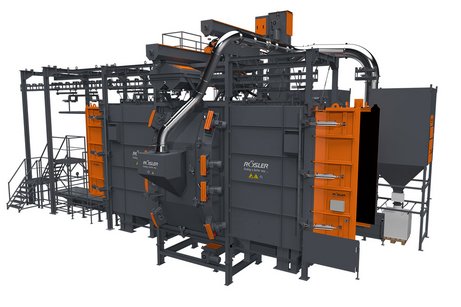
When a Polish manufacturer of complex steel weldments was ready to invest in a new shot blast machine, quality, capacity, high equipment uptime and integration into the manufacturing flow were the key selection criteria. As an essential part of the pre-treatment operation for a cathodic painting line, the new shot blast system had to produce optimal surface preparation results within an interlinked work flow in a 3-shift operation. The company chose a Rösler RHBD 17/32-K continuous feed spinner hanger blast machine because of its wear-resistant design and favorable operating costs. The specialty of the Stelweld Sp.o.o. is the production of complex steel weldments, including machining, laser and CNC cutting, bending as well as wet painting and powder coating. With this market philosophy the company, founded in 1997, has established itself as a key supplier for such diverse industries as automotive, agricultural and construction equipment, cranes, including all kinds of lifting equipment, renewable energy and rail transport. Among many other companies Stelweld also sells its products to Scania, Volvo, Bombardier and Cargotec. In the year 2019 a new building was erected to provide space for a new, fully automated cathodic painting line (KTL) with 16 operating stations and a power & free transport system. Danuta Dobrzynska, project manager at Stelweld, comments: „Within the framework of this expansion we also wanted to automate the shot blasting operation and integrate it into the painting line. To date, the paint preparation process was predominantly done manually”. Sturdy equipment design and convincing test results A high capacity, excellent shot blasting results, an outstanding equipment uptime and a high cost efficiency were the other key selection criteria. Among the five shot blast equipment manufacturers who were considered as potential suppliers, the customer chose Rösler with its continuous feed spinner hanger blast machine RHBD 17/32-K. „I was familiar with Rösler through a project I dealt with, when working for another company. Rösler does not offer the lowest price. But with regard to quality and technical features this supplier offered many advantages. Compared to the competitive products all essential components of the Rösler shot blast machine consist of wear-resistant materials, such as the throwing blades of the turbines, which are made from forged tool steel”, explains Danuta Dobrzynska the decision for Rösler and continues: „Another key factor for our decision were the results of the shot blasting trials that were conducted with some of our original components. In the Customer Experience Center at Rösler we achieved excellent shot blasting results, which provided valuable pointers for our actual shot blasting operation”. Technical features that ensure excellent results, outstanding efficiency and high uptime The continuous feed spinner hanger blast machine RHBD 17/32-K allows the blast cleaning of a very wide spectrum of three-dimensional weldments with dimensions of up to 2,500 x 1,200 x 3,000 mm (L x W x H) and weights of max. 1,250 kg. At cycle times of 6 to 8 minutes the automatic shot blasting process produces a finishing quality of SA 2,5 on the entire surface of the steel weldments and surface roughness values that are in full compliance with the standards defined by Stelweld and its customers. This ensures an excellent paint adhesion on the work pieces. To achieve such demanding results, the shot blast machine is equipped with 16 Gamma 400G turbines, each with a drive power of 15 kW. These high performance turbines, developed by Rösler, are furnished with throwing blades in “Y” design. Compared to conventional turbines, the special blade geometry with its precisely calculated curvature produces a very high throwing speed with, at the same time, a lower energy consumption. This results in an up to 20% higher shot blast performance. Moreover, because of their symmetric design both sides of the throwing blades can be used resulting in a two-fold increase of the usable blade life. Thanks to a special quick-change system blade changes can take place without having to dismount the turbine. The turbine placement (position and angle) was determined with a special simulation of the shot blast process. The highly focused blast pattern also contributes towards the high efficiency of the shot blasting process. In order to adapt the blast media throughput of up to 200 kg/min to the geometry of its steel components, Stelweld is utilizing three different shot blasting programs. The rotational speed of the turbines is adjusted by frequency inverters. This allows the precise control of the impact energy of the blast media on the work piece surface. For optimum wear protection and, thus, a long equipment life, critical sections of the inlet and outlet chamber are fabricated from 6 mm thick manganese steel. The same material, this time 8 mm thick, is used for the blast chamber. Furthermore, the blast chamber is protected by overlapping, easy-to-replace wear plates made from high-strength materials. Sturdy rubber curtains in the inlet and outlet chamber, as well as the protection of gaps with multiple rubber seals and brushes, prevent any blast media spillage to the immediate environment. „The turbines, the entire equipment design and the used materials guarantee a high uptime. This ensures a safe, trouble-free and energy-efficient operation”, concludes the project manager. Fully automatic, interlinked operation produces repeatable high quality The power & free transport system transports the steel weldments, containing a QR code for the automatic selection of the respective shot blast program, to the shot blast machine. As soon as a trolley with one work piece has entered the inlet chamber, the double leaf doors are closing, and the turbines, the blast media return system and dust collector are starting automatically. During the shot blast process the work piece is passing through the blast chamber at a pre-defined speed. The 16 blast turbines ensure an intensive cleaning of all work piece areas with highly homogeneous and consistent shot blasting results. Two dropout boxes placed in the duct connection between shot blast machine and dust collector make sure that the generated dust is evacuated from the blast chamber, whereas re-usable blast media is returned into the shot blast machine. The shot blast machine is accessible behind the outlet chamber. This allows the manual removal of residual blast media from the weldments, especially those with cup-shaped sections. An auger in the bottom returns the removed blast media to the media recycling and cleaning system consisting of two cascade air-wash separators. Subsequently the blast cleaned work pieces are transported to the KTL painting line. Danuta Dobrzynska concludes: „Compared to our previous manual shot blast operation the new shot blast machine achieves considerably better and much more consistent shot blast results in a much shorter time cycle. This allows us to employ our qualified personnel for more productive work, helping us to create more added value. Through savings in energy consumption and other operating costs the overall shot blasting operation has become considerably more economical”.
Rösler Smart Solutions

Webbasierte Fernwartung: Rundum-Sorglos-Service für Ihre Strahlanlage

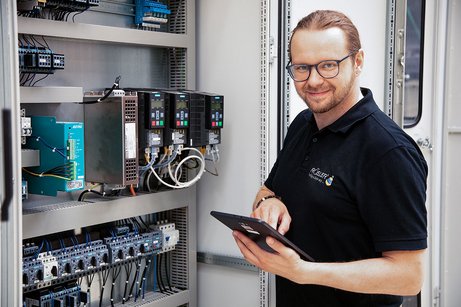
Um Stillstandzeiten bei Strahlanlagen möglichst gering zu halten, gehört für viele Unternehmen eine vorausschauende Wartung zum Pflichtprogramm. Bei auftretenden Problemen ist es häufig notwendig, dass Servicepersonal des Herstellers ins Unternehmen kommen muss, um die Störungsbeseitigung durchzuführen. Das kann wertvolle Zeit kosten. Schneller und individueller Wartungsservice dank Wartung 4.0 Mit unserem webbasierten Fernwartungssystem mit Ethernet Verbindungsleitung zur SPS bieten wir Ihnen die Möglichkeit, die Fehlerdiagnose Ihrer industriellen Anlagen und Geräte mittels Fernzugriff auf Abruf und in Echtzeit zu realisieren. Durch einen gesicherten VPN-Tunnel wird im Bedarfsfall mittels Kundenfreigabe eine automatisierte Datenverbindung hergestellt, die es unseren Servicetechnikern ermöglicht, eine schnelle Fehleranalyse vorzunehmen. Auch die unmittelbare Anpassung an der Maschinensteuerung ist im Bedarfsfall möglich. Hierdurch können Sie die wartungs- und störungsbedingten Ausfallzeiten Ihrer Strahlanlage erheblich reduzieren. Mehrwerte: Gesteigerte Produktivität & Wettbewerbsfähigkeit durch unverzügliche Fehleranalyse und -behebung Nachhaltige Reduzierung der Instandhaltungskosten, da Einsätze an der Anlage auf ein Minimum reduziert werden Bereits ab dem ersten eingesparten Störungsfall können sich die Kosten für das Fernwartungssystem amortisieren Technische Aspekte: Maximale Sicherheit durch integrierte Firewall mit AES/SSL Verschlüsselung Durchgehende Nachvollziehbarkeit und Zugriffskontrolle Fernwartungssystem per Hardwareschalter durch Kunden zu – und abschaltbar, d. h. Zugriff auf SPS nur bei Kundenwunsch Zugriff auf alle im Subnetz verwendeten Teilnehmer möglich (SPS, OP, Umrichter, etc.)

Patient-Specific Implants Call for Equally Customized Processing

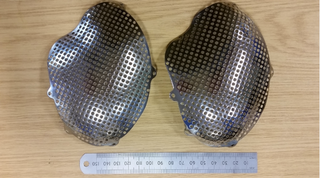
Advancements in medical technology now allow for the development of Patient-Specific Implants (PSI). Specialized computer programs analyze x-rays, ultrasound, and MRI images to create surgical guides, tools, and implants tailored to the patient’s unique anatomy. While still emerging, many medical industry suppliers have received FDA approval for PSI use. Like traditional implants, these implants must be carefully finished once created to ensure the work piece meets stringent medical safety standards while promoting patient comfort and long wear life. The benefits of PSI use include shorter surgery times, better surgical outcomes, and cost savings. True to its “apply innovation” tagline, Renishaw’s Medical and Healthcare Division has found great success in additively manufacturing PSI. Using CT scan-to-CAD software, one of the company’s most innovative advances is creating cranial plates using titanium powder. When determining how to finish the implants to precise medical requirements and surgical demands, Renishaw trusted Rosler for help with mass finishing . The Challenge Renishaw cranial plates after polishing Original commissioning neurosurgeon Bartolomé Oliver required the surface of Renishaw’s cranial PSI to be satin-like in order to best match the patient's cranial contours. Renishaw Applications Engineer Andy Wescott's job then became creating a repeatable and streamlined process to apply a satin and highly polished finish to the top of the cranial plates from their as-built condition. "Traditionally, post-processing these parts to a low surface roughness value was very manual and time-consuming," Wescott said. "The post-process time for a large cranial plate was up to five hours. We needed to reduce that time and the amount of manual input because if an operator working on a part loses concentration for one second, they could burn a hole in your part. “That makes one expensive bit of scrap." Finding a Better Way… Since metal additively printed parts are now of such quality, they can be treated like any other metal part. And Rosler knows a thing or two about surface finishing metal parts, having been in the post-processing game with its mass finishing and shot blasting divisions for more than 80 years. A more mechanized solution presented itself in the form of Rosler’s High-Energy Centrifugal Disc Finishing Machine FKS04 . Now, after a cranial plate comes out of the Renishaw AM250 machine, it undergoes only a small amount of manual operation to remove supports from printing and slightly improve the surface using a carbide burr and flap wheel. It is then placed into Rosler’s FKS where it automatically goes through a three-step process to produce the impeccably smooth finish, reducing manual operating time to under an hour. The clever part, which ensures repeatability on each and every part, comes from a little bit of Renishaw engineering know-how. "We designed a tool to hold our parts in a particular orientation inside the tumbling bowl,” Wescott said. “Rather than just throwing parts into three media types and coming out with a sort of fixed part, our parts require precision. Certain features require protection from the tumbling media, so we've invented a tooling method that keeps parts face down in the media and only applies the surface finish where needed." The Rosler Way Although there isn’t a one-size-fits-all solution for finishing, the collaboration between Renishaw and Rosler demonstrates that post-processing doesn’t have to be a grueling experience. Much like the additive manufacturing process itself, your finishing technique depends on your unique application. Contact Rosler today for help in finding a better way to meet your finishing needs.
Croom chooses Rösler as a strategic partner

Croom chooses Rösler as a strategic partner

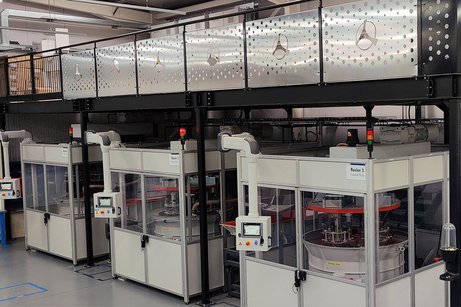
Croom Precision Medical chooses Rösler as a strategic partner for the design, manufacture and installation of a dependable orthopaedic implant finishing system. This was no exception when Croom Medical approached Rösler with their plans to expand and increase their production & throughput of medical implants. As an industry leader in utilising high-tech, high-growth, cutting-edge medical device manufacturing technology, Croom Medical has over 37 years’ experience in partnering with global healthcare companies as an outsourced manufacturing service of high precision components and medical devices. The cooperation throughout the project from Croom Medical, the end customer and the personnel involved within the Rösler organisation, both in the UK & Germany, was indispensable from the initial contact through to the final installation & commissioning. The project itself and timeframe was completed within the expected timeline and also, in part, took place under some rather complicated circumstances (COVID-restrictions and required protocol) however, with the support from all at Croom Medical to our installation and engineering team, everything resulted in a commendable operation. With the installation now in place, Croom Medical can immediately proceed with the validation processes to fulfil their promise to their customer and subsequent commitments to patients. The Rösler equipment is designed to polish implants to an agreed standard, set within the industry, where surface finishing after machining is stipulated to provide consistent and reproducible results in a controlled process. The advantage of the Rösler designed system is the ability to finish multiple implants at a time based on the required batch size, which in turn reduces overall cost per part compared to other traditional finishing methods.
Separation of parts

Excellent finish for deep-drawn precision medical components

Deep-drawn functional components are increasingly being utilized in the production of medical and pharmaceutical products. To also meet the strict standards for manufacturing and quality management in the field of surface finishing, Stüken Medical relies on mass finishing solutions and consumables from Rösler. In order to meet the increasing demand for deep-drawn metal components in the field of medical and pharmaceutical engineering, a few years ago the Hubert Stüken GmbH & Co. KG, founded in 1931, established the business division “Stüken Medical”. The product range of this family-owned company includes also stamped and bent parts, plastic-coated components and complex assemblies. The company maintains manufacturing operations at five locations in Europe, Asia and the United States. Andreas Hellman, manager of the ISO 13485 certified business division, explains: „Components used in the field of medical and pharmaceutical engineering must meet strict quality standards. The same strict standards apply also to the actual production operations. For this reason, we have pooled the required knowhow for the development and production of such precision components at Stüken Medical”. Among other items, this division produces complex housings and assemblies, valves, extremely precise micro parts and primary packaging. These components are made from metals suitable for deep drawing, such as stainless steel, aluminum and titanium. To meet the strict quality standards in the medical and pharmaceutical industry, the company utilizes multi-stage cleaning systems and operates two class 7 cleanrooms. The company’s R&D and development department, located at the corporate headquarter in Rinteln, Germany, is continuously exploring the possibilities to expand the range of processes and materials. A team approach for innovative solutions „For many of our customers we are a development partner. To perfectly adapt new products to their intended use, we are not only working with our customers but are also cooperating with partners from various technological sectors”, continues Andreas Hellmann. When it comes to issues around surface finishing that can be resolved by mass finishing, for 30 years the company has been relying on the experience and knowhow of the Rösler Oberflächentechnik GmbH. Andreas Heilmann explains further: „Our long partnership is based on the excellent quality and reliability of the Rösler equipment and consumables. This helps us to ensure that the required results are achieved in a consistent manner”. Dirk Schulz, project engineer at Stüken, adds: „When it comes to the joint development of finishing processes, we value especially the flexibility and expertise of Rösler. In this respect, our access to the Customer Experience Center in Untermerzbach is extremely valuable. Rösler supports us also with documentations and equipment details, required for machinery and processes that must be qualified and validated in line with ISO 13485. At its manufacturing locations around the world this deep-drawing specialist is using around 15 rotary vibrators and 10 centrifugal disk finishing machines for its finishing operations. The company is also operating 18 centrifuges for the eco-friendly and reliable cleaning and recycling of the process water. Strict requirements for the finishing results The deep-drawn components are generally characterized by an extensive degree of material shaping, complex geometries and extremely small dimensions requiring a high dimensional accuracy. This results in especially demanding specifications for deburring, edge radiusing and polishing of external and internal work piece areas. Equally challenging are the surface roughness and surface quality requirements. Dirk Schulz explains: „On the one hand we must ensure that all pieces within a work piece batch receive the same high-quality surface finish. On the other hand, the work pieces must not be damaged or deformed. Last-but-not-least, after completion of the finishing process the work pieces and media must be reliably separated. A carry-over of the work pieces and/or media into the next batch must be prevented at all costs”. In conjunction with polishing jobs, the work piece surface must frequently be marked with an UDI code. To fully meet these specifications requires not only finishing processes that are precisely tailored to the respective work pieces. Likewise, the equipment and consumables must also be adapted. Frequently, this requires conducting special feasibility studies. A process for finishing medical components The process for radiusing the edges on a 20 mm large stainless steel housing for a medical device was developed in close cooperation with Stüken. The project engineer explains the finishing task as follows: „With this delicate housing the main challenge was a large surface area in combination with extremely thin walls. To remove sufficient material at the edges requires a high processing intensity. But the intensity must be tightly controlled to prevent any deformation”. The Customer Experience Center at Rösler is equipped with ultra-modern machines for running a wide variety of different finishing processes. This allows conducting processing trials for defining the most suitable equipment technology under actual production conditions. During such development processes, the processing bowl of standard machines must be frequently modified, sometimes involving substantial engineering changes. For this project, the comprehensive mass finishing experience at Stüken was a valuable source of ideas. To guarantee a reliable and complete separation of the finished work pieces from the media the finishing equipment for Stüken Medical required a few changes in the separation process. Another goal of the processing trials is the determination of the optimal media shape and type (ceramic or plastic) for the finishing task at hand. In order to achieve consistently good surface finishes, very often the media must have extremely tight dimensional tolerances. All ceramic and plastic media are produced at Rösler in compliance with the highest ecological standards. With over 15,000 different products the media, together with the compounds and process water cleaning agents, represents the by far largest range of mass finishing consumables in the world. Key factor for the development of successful finishing processes is the perfect interplay between the right equipment technology and the right consumables (media and compound). Generally, the best results are achieved by close cooperation with the customer. Photos: Hubert Stüken GmbH & Co. KG

Wet Blasting Equipment & Media, Part 2 – Technical Components Combine for Systematic Success

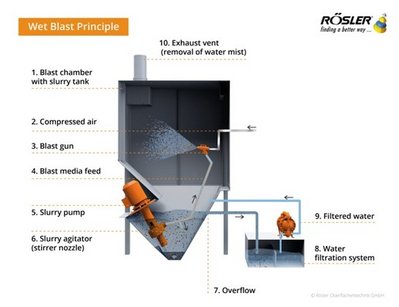
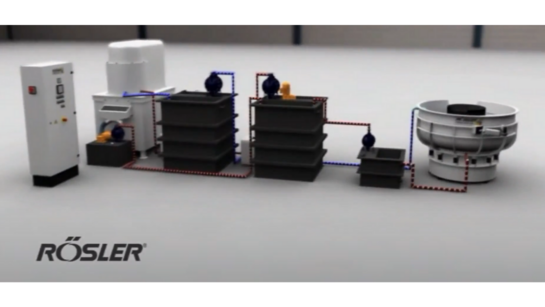
Wet blasting technology lends itself to a variety of processes and industries . From applying cosmetic (anti-glare) finishes and surface smoothing to deburring , de-powdering, decontaminating, and cleaning after casting, welding, and additive manufacturing , wet blasting has many capabilities. Rosler has decades of worldwide experience developing technology and machines customized to each customer’s unique challenges and demands. Each solution we deliver is innovatively designed around core wet blasting components and calibrated to your work piece with carefully selected media and tested process parameters. Basics Components Wet Blast Principle Diagram Regardless of their uses, all Rosler wet blasting machines start with a core group of components. While customized options and accessories can be added, these systems typically include 10 key components. Blast chamber with slurry tank – A mix of media and water is stored in this holding tank found at the bottom of the blast chamber. The chamber is made of stainless steel. Compressed air – Approximately 70 PSI of compressed air accelerates the slurry. Blast gun(s) – One or more guns accelerate the slurry supplied by the slurry pump with compressed air. Blast media feed – This component supplies the media slurry to the blast nozzle. Slurry pump – This high-powered mechanism transports the slurry to the blast gun(s). Larger wet blast systems can be equipped with multiple pumps. Slurry agitator (stirrer nozzle) – In order to keep the media suspended in the water, the slurry pump diverts some of its flow to a stirrer nozzle placed in the tank to agitate the mix of water and abrasives. Overflow – Small media particles, dirt, and other contaminants tend to stay suspended and are skimmed off and sent to the filtration unit. Water filtration system – Media particles and debris skimmed off the water’s surface must be passed through a filtration system to separate still usable media and process water from waste. Common filtration methods include hydrocyclones, weir tanks, bag filters, paper band filters, and semi- and fully automatic centrifuges. Filtered water – Once processed by a water filtration system, water is returned to the slurry tank and reused. Exhaust vent – The water mist mixed with media fines and other small particulates is removed from blast cabinet by suction fan-equipped filters. The Rosler Way We have the experience and expertise to meet your wet blasting needs. Rosler partners with you to find a better way, the best machine, and the best finishing results. Contact us today to discuss your unique challenges. Previous posts in the Wet Blasting Equipment & Media series include: Part 1 – “Machines Range in Complexity, Uses.” Part 2 – “Technical Components Combine for Systematic Success.” Part 3 – “Maintain Slurry Concentrations for Finishing Consistency.” Upcoming posts will include: Part 4 – “Internal Cleaning, Rebuilds Prolong Machine Lifetime.” Part 5 – “Careful Media Selection, Additive Use Impact Results.” Sign up for enews alerts to be notified of new posts!
Ausbildung 2021

Ausbildung & Studium in der Region: Rösler bildet seit über 43 Jahren erfolgreich aus

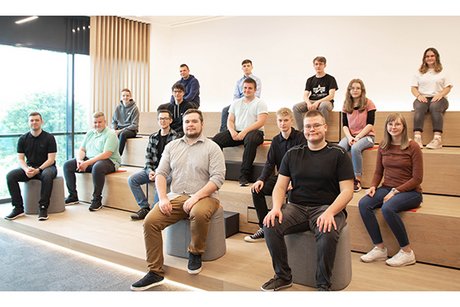
Insgesamt 15 junge Menschen beginnen am 01. September 2021 eine Ausbildung in einem technisch-gewerblichen oder kaufmännischen Beruf – sowie in dem dualen Studiengang der Wirtschaftsinformatik. Auch in schwierigen Zeiten will der Spezialist für Oberflächentechnik den künftigen Bedarf an bestens ausgebildeten Fachkräften selbst decken. Rösler bleibt somit ein wichtiger Arbeitgeber und Ausbildungspartner für die Region. Trotz der anhaltenden Corona-Pandemie setzt das familiengeführte Industrieunternehmen aus Franken auch in anspruchsvollen Zeiten auf eine nachhaltige Ausbildung von qualifiziertem Fachpersonal – und das seit mehr als vier Jahrzehnten. „Wir verstehen die Ausbildung als ein langfristiges Instrument und dieses braucht Kontinuität“, sagt Anja Süppel, Ausbildungsleiterin der Rösler Oberflächentechnik GmbH, die selbst Ende der 80-er Jahre ihre Ausbildung bei Rösler begann. „Das Thema Ausbildung liegt mir persönlich am Herzen. Viele der heutigen Führungskräfte haben ihre Ausbildung bereits im Unternehmen absolviert, so habe ich auch hier meine Ausbildung zur Industriekauffrau einst erfolgreich abgeschlossen. Zudem konnten wir in den letzten Jahren eine Vielzahl von Auszubildenden in ein langfristiges Beschäftigungsverhältnis übernehmen, damit sichern wir fortwährend Know-how im Unternehmen“. Spannende Projekttage verhelfen zu einem guten Start Schon fast traditionell finden in der zweiten Ausbildungswoche die Rösler Projekttage statt. Diese verschaffen den jungen Nachwuchskräften erste Einblicke in die wichtigsten Geschäftsbereiche des Unternehmens, dienen der örtlichen Orientierung und bieten zudem die Möglichkeit, sich untereinander besser kennenzulernen und als Team zu wachsen. Höhepunkt und Abschluss der Projektwoche ist das gemeinsame „Outdoor-Training“ auf dem Gelände der Freizeit- und Tagungsstätte CVJM in Altenstein. Themen wie „Knigge im Berufsalltag“ oder „Schlüsselqualifikationen“, aber auch ein „Kreativ-Workshop“ sind Topics für die ersten Tage. Mitte September startet bereits die heiße Phase für die Bewerbungen um die Ausbildungsplätze 2022. Das vielfältige Ausbildungsangebot reicht von unterschiedlichen Berufen des technisch-gewerblichen über den kaufmännischen Bereich bis hin zu dualen Studienangeboten. Die Rösler-Gruppe bietet für das Jahr 2022 folgende Ausbildungsplätze an: Industriekaufleute, Chemielaboranten, Technische Produktdesigner, Konstruktionsmechaniker, Industriemechaniker, Mechatroniker, Elektroniker für Betriebstechnik, Fachkräfte für Lagerlogistik, Fachinformatiker. Ein dualer Studiengang ist möglich im Bereich Wirtschaftsingenieurwesen, Wirtschaftsinformatik, Elektrotechnik oder Maschinenbau. Die Partnerhochschule von Rösler ist die Duale Hochschule in Mosbach. - Unabhängig von der Formulierung richten sich alle Ausbildungsangebote an alle Geschlechter gleichermaßen. - Online-Bewerbungen sind ab sofort möglich über die Internetseite: www.rosler.com Bei Fragen zu Ausbildung/Dualem Studium gibt Anja Süppel gerne Infos unter Tel.: +49 9533 / 924-442 oder per E-Mail an: a.sueppel@rosler.com

Centrifuge Technology, Part 5 – Potential Issues and Remedies for Water Recycling

Trial and error are often the origin of innovation. As such, mass finishing and centrifuge technology have been advanced by building upon what worked and avoiding what didn’t. With more than 80 years of experience, Rosler has extensive engineering knowledge and troubleshooting skills. An overview of the top three issues centrifuge water recycling systems experience along with possible remedies are summarized here. As always, trust a partner such as Rosler to consult on your specific issues. Excess Oil in the System Too much oil may be carried into the finishing system by the work pieces, for example, in stamping operations. The excess oil will negatively affect the mass finishing process. The media might become “glazed” causing longer processing times and poorer finishing results. In addition, the finished work pieces may also be contaminated with oil residue. Possible remedies include cleaning of the work pieces prior to mass finishing, for example, with an industrial washing machine, or switching to an alternative oil type that can be better emulsified by the compound for better discharge from the process water. Soft Water Process water that is very soft (i.e. less than 70 ppm or 4.2 gpg) can cause excessive foaming, especially, when plastic media is used. To correct this issue, make sure that you are using special recycling compounds , which are formulated to prevent excessive foaming such as Rosler compounds with the prefix ZF. Use of a defoamer, such as Rosler products ES 3, ES 4, and ES 7, can also correct excessive foaming caused by soft water. Bacteria & Fungus Contamination A very pronounced, foul smell from the process water often indicates bacteria or fungus contamination in the process water. Such contamination can be caused by a variety of factors, including: Longer shut‐down times and stagnation developed over the weekend or during process repairs and plant shutdowns. Too much oil carried into the finishing system, for example, by stampings. Dirt deposits in the form of media and metal fines in the water tanks and the piping. Numerous remedies are available based on the specific cause of bacteria and fungus accumulations, including: Using higher concentrations of special centrifuge compounds that are formulated to prevent bacterial growth such as the Rosler ZF compound range. Adding a biocide to the system to prevent bacterial growth. Ensuring that the process water is always in motion by using stirrers or other aeration methods. Reducing the length of time process water is used before replacement. Periodic cleaning of the tanks and piping, especially during a process water change. The Rosler Way When correctly designed, calibrated, and monitored, centrifuge technology can produce water and compound savings of up to 95% while simultaneously delivering precise mass finishing results. Whether you are researching new equipment or troubleshooting an existing process, contact Rosler for assistance and innovative solutions. Previous posts in the Centrifuge Technology series include: Part 1 – “Water Cleaning Systems Replace Outdated Methods.” Part 2 – “Operational and Economic Benefits of Recycling Process Water.” Part 3 – “Mechanics and Limitations of Water Recycling.” Part 4 – “Pre-Conditions and Consumables Enhance Process Efficiency.”

Mass Finishing Water & Compounds, Part 2 – Precise Water Flow, Dosing Drive Results

A number of factors contribute to mass finishing success. Machinery, consumables , compounds , and process water must be evaluated individually and as a whole to create optimal results and stable process conditions. When considering the flow rate of compound and process water into the processing bowl of a mass finishing machine, careful calibration is required based on the machine type and size, finishing task, condition of the raw work pieces, and process water conditions. For example, high‐energy machines require a much higher flow rate than vibratory finishing systems. Similarly, work pieces heavily contaminated with oil, grease, and/or dirt require more compound and water than less contaminated work pieces. Water flow and compound dosing rates are usually determined by processing trials in the test lab of the equipment supplier. Once a finishing process has been defined, the user must make sure that the established water and compound flow parameters are precisely maintained. This requires a well-calibrated and well-maintained dosing system. At Rosler , we draw upon more than 80 years of worldwide experience to create and maintain effective mass finishing systems and deliver precise results. Our ability to do so is thanks, in part, to understanding the importance of water flow and compound dosing. Compound & Water Dosing Systems While the specific machines and processes they support range widely, basic components of compound and water dosing systems are quite similar. Basic components of a compound and water dosing system Each system includes the following components: Electronically controlled solenoid diaphragm pump for precise compound dosing Manual water shut‐off valve Water pressure reducer Solenoid valve for turning water flow on/off Manual valve to adjust the water flow Water flow meter How It Works The dosing pump (1) injects the compound directly into the machine. Specific dosing rates can range between 0.4 to 2% of the water flow. A freshwater inlet (2) serves as a manual shut-off valve. The water flow is caused by the water main’s pressure. If the pressure exceeds 60 PSI, it must be lowered with a water pressure reducer (3). Water flow is turned on or off using a solenoid valve (4). When on, the water flow rate is adjusted to the desired flow rate with a manual valve (5). The flow rare can be monitored with the built-in flow meter (6). Adapting to Change If working conditions change, the compound and water flow parameters should be revaluated and accommodated as needed. Changes that may require parameter adjustments include, but are not limited to: Switching the material for die‐castings from aluminum to magnesium. Adding new stampings to the work piece range and carrying more oil into the mass finishing machine. Changes in the workflow which require better corrosion protection. Too much foam in the machine. Spots suddenly appearing on finished work pieces. A desire to use a lower-cost compound, etc. In each of these cases, seeking professional advice from the experts at your equipment and/or compound supplier is advised. Rosler recycling tank combination Maintaining & Enhancing Your System Basic maintenance is key in delivering precise finishing results as well as minimizing process downtime. Regularly checking all connections for unwanted leakages and examining the pump diaphragm for wear and/or damage are essential. Make sure that the compound pump delivers the right amount of compound as well. If necessary, recalibrate the compound dosing pump. Installing and monitoring a precise compound dosing system will improve the finishing results, enhance process stability, and reduce costs. These systems can be retrofitted onto any mass finishing machine. The Rosler Way At Rosler, our mission is to learn about our customers’ needs and issues in order to develop and deliver solutions. Contact us today to discuss your water flow and dosing challenges. We’ll partner with you to find a better way! The Mass Finishing Water & Compounds Series also includes Part 1 – Identifying, Correcting Hard and Soft Water Conditions.

Wet Blasting Equipment & Media, Part 1 – Machines Range in Complexity, Uses

Because of its many technical advantages and versatility, wet blasting is the fastest-growing segment in the field of shot blasting . As with dry blasting, the available scope of wet blasting machinery ranges from simple, low-cost blast cabinets to sophisticated, partially or fully automated systems . Customers can choose between a wide spectrum of standard wet blasting equipment, however, for certain applications, special custom-engineered systems may offer the most efficient and cost-effective solution. The machine type is usually determined by the processing task, the size and shape of the work pieces, and the desired degree of automation. Frequently, multi-axis robots are used for work piece handling or guiding the blast gun movement. Rosler has extensive experience in wet blasting technology and the development of customized solutions. We have even developed the Rosler PureFinish® system for cleaning stainless steel components for the chemical, food, and pharmaceutical industries through wet blasting. This system cleans the work piece surface while facilitating cleaning, sterilization, and prohibiting bacterial growth. Learn more about common types of wet blasting systems and examples of machine use for a glimpse into the technical capabilities wet blasting offers. Manual Blast Cabinets Capable of processing work pieces weighing up to 500 lbs (230 kg), the Rosler VB 100 H manual blast cabinet with retractable turntable removes radioactive particles from stainless steel components in nuclear power plants. Blast cabinets are ideal when a variety of part sizes and materials are processed by a single wet blast system. The cabinets can be equipped with turntables, baskets, blast nozzles, pressure blasting systems, oscillators, and other special auxiliary equipment, making them very versatile. The large side access doors provide clear access to the complete blast chamber. Satellite Table Machines The Rosler Satellite Table Machine RWB 72 12/4 is equipped with three blast stations and one load/unload station. Each of the three blast stations houses four blast guns. Customized to meet the customer’s work piece size and ideal batch times, satellite table machines are built with an indexing satellite table and equipped with a variable number of work stations and blast guns. The various configurations allow one or more stations to operate while a designated station is loaded/unloaded to allow for continuous processing. Robotic Wet Blast Machine Rosler’s robotic RWB models feature robotic movement of the blast gun(s) for treating small- to midsized-work pieces including de-powdering, general cleaning, and surface smoothing. Capable of processing plastic and metal work pieces, robotic wet blast machines offer all the advantages of regular wet blasting machines with less need for human intervention. Drop Door Wet Blast Machines with Robotic Gun Movement Capable of cleaning work pieces of up to 1,000 lbs (460 kg), Rosler’s special ASPE 1520 RH machine with robotic movement is used to remove machining lines from high-precision components. Ideal for large, heavy work pieces, wet blast machines featuring drop doors and robotic gun movement are often used for oversized and specialized work pieces. The drop door allows for easy loading and precise positioning of the work piece. The robot can reach all critical areas of the part. Blast Rooms Rosler’s Wet Blast ABR 10 x 8 is used for general surface cleaning including the removal of welding lines for all kinds of large, stainless steel components specifically made for the chemical, food, and pharmaceutical industries. For manual wet blast cleaning of large, bulky stainless steel components, blast rooms offer useful versatility. They can be built in practically any size. Finding a better way… Rosler has more than 80 years of experience in shot blasting. Whatever your wet blasting challenges are, we are confident that we can deliver a solution. Contact us to discuss your needs today! Previous posts in the Wet Blasting Equipment & Media series include: Part 1 – “Machines Range in Complexity, Uses.” Part 2 – “Technical Components Combine for Systematic Success.” Part 3 – “Maintain Slurry Concentrations for Finishing Consistency.” Upcoming posts will include: Part 4 – “Internal Cleaning, Rebuilds Prolong Machine Lifetime.” Part 5 – “Careful Media Selection, Additive Use Impact Results.” Sign up for enews alerts to be notified of new posts!

New shot blast machine increases capacity, improves quality and optimizes manufacturing efficiency

Due to continuously growing demand for its products a globally leading supplier of iron castings had to increase its shot blasting capacity. At the same time, the new shot blast machine was intended to improve overall product quality and streamline the production flow. The company chose the Rösler wire mesh belt blast machine RDGE 1250/300-8, because it offered a custom-engineered solution and because of the customer’s positive experience with Rösler from previous projects. The Gienanth GmbH, located in Eisenberg in the German Palatinate area, has a long history that reaches back to the 15th century. This history has been characterized by tradition, comprehensive knowhow and innovation in the field of cast iron components. Today, Gienanth produces its products at four locations in Germany, Austria and the Czech Republic. Besides engine blocks for large engines, utilized in ships, railways and generators, the company also produces components for all kinds of machinery as well as parts for the automotive and utility vehicle industry. This cast iron specialist considers himself as a solutions provider, who supports the customers along the entire value-added chain covering the generation of ideas, product development, material selection and production of the ready-to-mount components. With this integral approach the company has experienced a continuously growing worldwide demand for its products. It was also the reason for Gienanth receiving the German Innovation Award 2019 for the bionic re-design of the carrier plate for the brake pads in utility vehicles. High technical standards and difficult installation conditions Due to a steadily growing demand for the cast iron products the existing shot blast machines could no longer handle the higher production volume. Jens Eckel, project engineer at Gienanth in Eisenberg, summarizes the technical requirements as follows: „With the new shot blast machine we intended not only to increase our capacity, but we also wanted to make the shot blasting operation more efficient and improve the overall quality.“ To achieve an acceptable uptime of the critical machine components the equipment design had also to take into consideration the highly aggressive, angular and extremely hard blast media and the fact that every hour around 200 kg of sand are carried into the shot blast machine. Another challenge was the building, where the shot blast machine had to be placed: Because of the sawtooth roof with its complex support structure the overall machine height had to be reduced by installing a split elevator. Custom-engineered wire mesh belt blast machine in particularly robust design "Rösler was willing to customize the wire mesh belt blast machine RDGE 1250/300-8 exactly to our technical requirements. Of course, another important factor in our decision for Rösler was the excellent experience we had with this supplier through previous equipment projects”, reports Jens Eckel. To adequately deal with the extremely harsh operating conditions for de-sanding and cleaning, the shot blast machine was equipped with eight high-performance Rutten Gamma 330-HD turbines, each with an installed power of 18.5 kW. The machine handles a blast media throughput of up to 2,520 kg per minute. The eight blast turbines are equipped with six throwing blades in the innovative “Y” design. Compared to conventional turbines this special blade geometry generates an up to 20% higher shot blast performance with a lower energy consumption. Another significant advantage of the “Y” blades is that both blade sides can be utilized by simply turning them around. For optimal shot blast results four turbines are placed in the roof and the other four turbines are located in the bottom of the blast chamber. The special requirements of the customer were a key factor for the particular placement of the turbines: To prevent the smaller work pieces, weighing only 1.0 to 1.5 kg, from changing their position, moving on top of each other or getting blown off the wire mesh belt, the turbines are mounted at a slight angle. This allows the blast patterns of the upper and lower blast turbines to meet precisely at the wire mesh belt so that the blast stream from the upper turbines holds the work pieces in place. At the same time, the somewhat higher blast performance of the lower turbines causes the work pieces to get slightly lifted from the belt. This eliminates the risk of shadowing. Fully automatic shot blasting operation that is fully integrated into the manufacturing flow A vibratory conveyor transports the raw castings directly from the casting cell to the shot blast machine. This vibratory movement already removes some of the sand from the castings. At the inlet section of the shot blast machine the work pieces are transferred onto the 1,250 mm wide wire mesh belt. An employee makes sure that the work pieces are evenly distributed on the belt. After the shot blasting operation the castings are transferred to a 15 m long transport system that was also supplied by Rösler. This special foundry conveyor, equipped with a particularly robust transport belt, transports the finished castings directly to the shipping department. Blast media recycling and cleaning system with a high cleaning efficiency The blast media recycling and cleaning system was also designed for optimal wear protection. The media/sand mixture is initially passing over vibratory screening conveyors placed below the shot blast machine. This allows discharging larger chunks of sand as well as residual scale and slag from the system. Subsequently, the mix is transported to a magnetic separator. There a finely tuned guide system distributes the media/sand blend over the entire width of the magnetic drums, thus generating a very thin curtain of media and sand. This precise curtain, in combination with the extensive magnetic force of the high performance magnets built into the drums, produces a cleaning efficiency of up to 99.8 percent. Dosing of the blast media also takes place automatically. For this purpose the media hopper is equipped with a level sensor. As soon as the media level falls below a pre-defined value, small media quantities are added to the system through a special media replenisher. This approach ensures a highly homogeneous media operating mix and guarantees consistent shot blasting results.

Hands-on research for knowledge-based mass finishing processes

Innovative solutions are the driving force for the continuous creation of added value. In this respect the cooperation between science and industry plays a central role. A good example is the cooperation of the research department technological planning and grinding technologies at the machine tool institute WZL at the RWTH Aachen university with the Rösler Oberflächentechnik GmbH in the field of mass finishing. For more than 10 years the two partners have been working together. The RWTH Aachen is one of the eleven German universities that are recognized as “universities of excellence”. When it comes to the fields of technology and natural sciences, the Aachen university is one of the most renowned academic and research institutions. For decades the machine tool institute, one of the largest and oldest establishments at the Aachen university, has been a globally recognized beacon for future-focused research in the field of manufacturing technologies. One reason for this success has been the close cooperation between the four academic sectors “measuring technologies in manufacturing”, “quality management”, “manufacturing systems” and “manufacturing and machine tool technologies” combined with a balanced mix of basic and practical research. Marius Ohlert, project manager for grinding technologies in the field technology planning and grinding methods, that is integrated in the academic sector manufacturing technologies, comments: „Through the close cooperation with a variety of industrial companies we make sure that our research projects are based on industrial needs and that the results can be quickly transformed into practical results”. Mass finishing as a research subject he mass finishing technology is a widely used system for all kinds of surface refinement tasks such as deburring, edge radiusing, surface smoothing, polishing, descaling and de-rusting. Despite the importance of this technology for many industries most mass finishing processes are still based on the knowhow of experienced experts. Mr. Ohlert describes one research goal as follows: „With our basic research we want to achieve that mass finishing processes are knowledge-based, thus allowing a quicker, more efficient and goal-oriented process development. For this purpose we study in detail the physical effects of the various mass finishing methods”. With application-oriented finishing tasks one objective is to improve already existing mass finishing processes so that the work piece quality can be improved. On the other hand, surface finishing processes must be developed for work pieces made from innovative new materials or for work pieces produced with new manufacturing technologies. For example, this is the case with fiber re-enforced ceramics, which are still under development. For the necessary processing trials the WZL uses its own equipment but also the comprehensive range of mass finishing machinery at the Customer Experience Center of the Rösler Oberflächentechnik GmbH. Around ten years ago the manufacturer of mass finishing equipment and consumables entered a strategic alliance with WZL machine tool institute. „With Rösler we have a partner, who is highly motivated to further develop the mass finishing technology, not only within the company but also in cooperation with us. For this purpose we are constantly communicating with the company’s R & D department. From this information exchange about developments in the field of science and the experience in the industry we frequently identify questions and subjects for future projects”, explains Marius Ohlert. Additive manufacturing promotes investments in new finishing methods For example, such projects deal with the post processing of components, which are produced by either 3D printing or hybrid manufacturing technologies in such diverse industries as aerospace, automotive, medical engineering and tool manufacturing. The project manager continues: „The high design freedom of additive manufacturing allows the creation of components not possible with traditional manufacturing methods. For the post processing of these complex components the mass finishing technology is, compared to classical machining systems, much better suited. The activities in this field, which Rösler pursues under the brand name AM Solutions-3D post processing technology, are especially valuable for the cooperation with the WZL institute. They were also the reason for investing in two new finishing machines, which we purchased in close cooperation with the colleagues from a partner institute that deals intensively with additive manufacturing”. Moreover, this investment allows the WZL institute also to further demonstrate the possibilities of the mass finishing technology for the basic research as well as for specific industrial projects. The institute purchased a surf finisher 700, a special rotary vibrator R 150 DL-2 and a semi-automatic centrifuge Z 800 K-HA Turbo-Floc for cleaning and recycling the process water from the mass finishing machines. State-of-the-art technology for optimal process development BThe surf finisher is a mass finishing system that allows the fully automatic, precise processing of entire work pieces or the targeted finishing of selected work piece surface areas with a wet or dry process. The plug-and-play system is equipped with an integrated robot that holds the work piece into the rotating processing bowl filled with grinding media. If required, the robot can also guide the work piece through the processing bowl with pre-programmed, computer-controlled movements. This allows the finishing of different work pieces with an individualized, pre-programmed process. The special rotary vibrator allows the surface grinding, smoothing or high gloss polishing of work pieces with complex shapes. The components, attached onto special fixtures, are mounted in the processing bowl of the vibratory system. Imbalance motors attached to the processing bowl induce a vibratory movement into the mounted work pieces. In turn, during the entire cycle time the processing media flows evenly through and around internal channels, undercuts and the work piece contours. The new, semi-automatic centrifuge thoroughly cleans the process water from both mass finishing machines so that the cleaned liquid can be re-used for the finishing operation. This is not only advantageous for environmental reasons but also for reasons of sustainability. Exchangeable processing bowls ensure maximum flexibility The processing bowls of the surf finisher and the special rotary vibrator can be easily exchanged. This allows a highly flexible utilization of the new finishing machines and, therefore, fulfills a key requirement of the WZL institute. The processing results depends not only on how the work pieces are handled but also on the selection and the flow characteristics of the media in the processing bowl. Marius Ohlert concludes: „For our studies it is essential to vary the media flow as well as the work piece handling, be it through a robot, mounting the work pieces to a fixture or having them loosely tumbling in the media. Of course, our studies also include the use of different media types, shapes and sizes. In this respect it helps that Rösler develops and produces all its media in-house so that we can rely on the company’s entire spectrum of ceramic and plastic media”. The studies concerning the stability and repeatability of mass finishing processes and the increased use of the new finishing systems for the post processing of 3D printed components require a lot more processing trials with higher work piece quantities. Rösler and the WZL institute at the RWTH Aachen university are jointly meeting this challenge to be ready for the mass finishing requirements of tomorrow.

Mass Finishing Water & Compounds, Part 1 – Identifying, Correcting Hard and Soft Water Issues

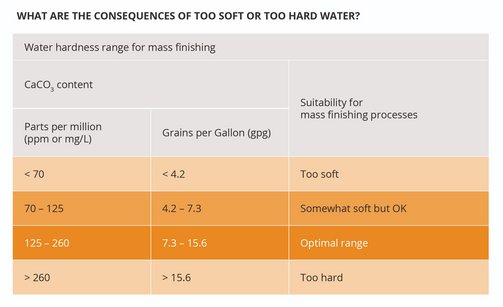
Achieving the desired surface conditions in a mass finishing process requires the machinery, consumables , compounds , and process water to work together in a balanced manner. Independent of the other process elements, the process water itself must be evaluated for hard and soft water issues. Rosler has more than six decades of experience designing mass finishing machinery, supplying consumables and compounds, and developing processes. Understanding the ramifications of too hard or too soft process water is a key to our success. Classifications and Measurements Depending on its geological source, the water used in mass finishing processes may have varying mineral content levels, specifically calcium and magnesium carbonates, bicarbonates, and sulfates. A high amount of mineral content is used to classify the water as "hard", whereas low mineral content classifies it as "soft". Based on the contents of calcium carbonate (CaCO3) in the water, the U.S. Geological Survey further describes water as soft, moderately hard, hard, and very hard. The most common classification systems measuring the amount of calcium carbonate in the water are parts per million = milligrams per liter (ppm/mg per L) or grains per gallon (gpg). Utilizing water that is too hard or too soft can create processing issues including ineffective finishing and system damage. Water hardness ranges and possible mass finishing consequences include: Extremely Soft Water (under 70 ppm) - Because of extensive foaming, compounds can only be used at low concentrations. This dosing is too low for the desired cleaning and/or rust protection effect. To overcome these issues, add a water hardener or defoamer. Somewhat Soft Water (70 ‐ 125 ppm) – Water within this range is marginally okay. Foaming may be problematic or manageable depending on the specific water condition and processing needs. Optimal Range (125 ‐ 260 ppm) – This is the ideal range for mass finishing operations. No additional accommodations are needed for water hardness levels. Very Hard Water (over 260 ppm) – In this range, a higher compound dosing rate is required to prevent calcium salts from leaving spots on work pieces. The compound concentration should be increased until the work pieces are clean and free of spots. In some extreme cases, spots may not be totally preventable. Types of Foam Excessive foaming in a mass finishing process is an issue. This foam can have different causes. Thus, understanding what specific type of foam is being produced can help remedy the issue. Types of foam in mass finishing processes and possible resolutions include: “Dirt” foam – This type is often caused by plastic media fines. By increasing compound dosing rates or, if possible, changing from plastic to ceramic media , dirt foam can be reduced or eliminated. At times a change in the flocculant concentration or type might be needed to solve the problem. The mass finishing process utilizing plastic media pictured above created dirt foam resembling dense, dirty foam sometimes found on beaches. “Surfactant” foam – Excessive compound dosing rates and/or process water that is too soft produces foam. Reducing compound dosing rates is the first step. In case of too soft water, a hardener compound such as Rosler additive CA may be required. A defoamer such as Rosler ES might also be needed to reduce foam. Surfactant foam resembles foam caused by bubble bath. Rosler Smart Solutions Many, if not all of these potential issues with mass finishing water and compound rates can be identified and solved with Rosler’s new Rosler Smart Solutions technology. Using data from water monitoring tests and dedicated sensors, the patent-pending offering monitors conditions and identifies potential problems. Rosler Smart Solutions brings process knowledge and troubleshooting right to the fingertip of the operator. The interactive troubleshooting guide steers the operator through the corrective actions to prevent unnecessary process downtime and equipment damage. Versions of the technology are available for shot blasting and mass finishing processes. Rosler Smart Solutions’ first solution in the field of mass finishing deals with process water cleaning and recycling with centrifuges, an area that can be challenging for operators and maintenance personnel alike. A dashboard displays all relevant equipment and process data, allowing the user to obtain suggestions for immediate corrective action in case of detected problems or deviations. The Rosler Smart Solutions interface provides machine and process insights. The Rosler Way “Finding a better way…” is more than a motto at Rosler; it’s our mission. With more than 60 years of experience and a portfolio containing more than 15,000 equipment and consumable products, solving challenges is what we do. Contact us today to discuss your process water challenges! The Mass Finishing Water & Compounds Series continues with, “Part 2 – Precise Water Flow, Dosing Drive Results. Sign up for enews alerts to follow the Rosler Blog and be notified of new posts!
swing chamber shot blast machine RWK 6/12-2

De-sanding and deburring of aluminum castings in tight spaces

A smart shot blasting solution for integrated manufacturing lines Increasing demand for electric vehicles forces the automobile manufacturers to expand their manufacturing capacities. Among others, this also includes production lines for stator carriers. The surface refinement of these components after the casting operation with a Rösler swing chamber blast machine RWK 6/12-2 must be achieved in very short cycle times within an interlinked manufacturing process. For the fully automatic de-sanding and deburring of different stator carrier versions the Landshut plant of the BMW group has integrated the swing chamber blast machine RWK 6/12-2 into interlinked, digitized manufacturing lines. The compact dual chamber shot blast machine from Rösler allows the blast cleaning of the aluminum castings within a cycle time of 50 seconds. With the dual chamber equipment concept and robotic loading/unloading the unproductive equipment times could be drastically reduced. Efficient processing with practically no idle times and a small footprint Within the stator carrier manufacturing line the RWK 6/12-2 – including a part feeding system, robot, a blast media discharge station and a small storage area – requires a space of only 10 square meters. The RWK can handle carriers with a height of up to 1,200 mm and a diameter of max. 600 mm. The work pieces arrive on a conveyor belt from the de-sanding station, where most of the molding and core sand has been removed from the castings. The robot, placed in front of the shot blast machine, picks up one stator carrier at a time and places it on a special work piece fixture in the chamber facing the load-unload zone. In case of a work piece change the fixture can be exchanged within a few seconds. In the course of the casting process a data matrix code is inserted into the carriers. To protect this code from getting damaged during the shot blast operation, it is protected with a cover. For this purpose the Rösler engineers developed a mechanism that automatically moves the protective cover over the code after the carrier has been placed on the fixture. After completion of the loading stage the chamber turns by 180 degrees. This turn moves the chamber containing the raw part into the blast zone and the chamber containing a finished part into the load/unload zone. The robot removes the shot blasted stator carrier, moves it to the media discharge station for shaking out residual blast media and then places it into an intermediate storage location. Optimal equipment configuration allows short cycle times AFor this application the customer is using a zinc cut wire blast media. The media is accelerated and thrown at the stator carriers by two Gamma 300G turbines with a drive power of 15 kW each. These high performance turbines, developed by Rösler, are equipped with curved throwing blades in Y design. Compared to conventional turbines, the precisely calculated blade curvature generates a much higher media throwing speed. In turn, this results in an up to 20% higher shot blast intensity and a significantly lower energy consumption. The high blast intensity, combined with the dual chamber machine design, allows cycle times of max. 50 seconds. Another benefit of the gamma turbines is that the special Y design of the throwing blades allows the use of both blade sides. This practically doubles their usable life. With a quick change system the throwing blades can be replaced without having to dismount the turbine from the housing. Because of the work piece material (aluminum) and the blast media (zinc), the shot blast machine had to be designed with special protection against explosions. This included special ducting for the exhaust air and an explosion protected dust collector. Digitization increases process stability and operational safety In close cooperation with an automation specialist the Rösler engineers implemented a partial digitization of the shot blast machine. For example, a sophisticated visualization of the shot blasting operations and blast patterns of the two turbines allows changing the process parameters during the actual shot blasting process. In addition, the operator can observe “live”, which turbine is blasting on which work piece section. If needed, he can initiate changes, reposition the work piece in the blast chamber or modify the blast time. This may become necessary, if, for example, a worn casting mold causes more sand to be deposited on a certain work piece section than defined during the initial programming of the shot blast machine. The operating time is also continuously monitored. After having reached a certain operating hour threshold, the machine automatically provides information about necessary controls and maintenance work, for example, for the throwing blades, work piece fixtures or the protective cover for the matrix code. This helps minimize unplanned equipment down times and significantly increase the uptime of the machine. These are aspects, which are especially important for the cost-efficiency of automated manufacturing lines. Within the framework of its efforts to expand the digitization of its products, by mid 2021 Rösler will present further innovative digital developments in the shot blasting field under the brand name “Rösler Smart Solutions”.