Solution Finder
ZH
EN
DE
FR
ES
IT
NL
RU
菜单
关闭
关于我们
公司介绍
阶段性成果
罗斯勒 - 全球
可持续性
Experience Rösler
产品
振动光饰
抛丸/喷丸
干式电抛光
磨料与化学助剂
表面处理技术
Solution Finder
(current)
您的合作伙伴
Rösler 生态系统
服务
改造
过程工程
Rösler学院
数字化
客户体验中心
參考
Partners4Steel
搜索
创新
Blog
联系方式
展会和活动
经销商搜索
下载
安全数据表
Home
公司信息
隐私政策
网站
Home
产品
Solution Finder
SOLUTION FINDER
您的罗斯勒产品世界指南
只需点击几下,您就能找到适合您的需求的机器!
重置过滤器
结果:
237 文章
文章
产品
What are industrial surface finishing technologies?
Surface finishing, surface treatment and surface refinement of components to optimize their functionality: The surface condition of components (work pieces) produced at high volumes on an industrial level generally does not satisfy the needs of the end-users. Therefore, to comply with the end-user demands, these components must frequently undergo various surface refinement operations. This is achieved with different types of surface finishing or surface treatment technologies. Their goal is to make the component surface more resistant against premature wear for a longer service life, to make the surface esthetically more pleasing, or to make it more functional by, for example, improving its anti-friction characteristics and protecting it against premature corrosion. The goals are achieved by precisely defined surface treatment methods irrespective of how complex the shape of a component might be. In this respect it is essential that the chosen treatment method can reliably and consistently achieve the specified finishes. Moreover, the surface finishing results must not exceed the specified dimensional tolerances, so that the component geometry remains intact. The term surface treatment or surface finishing includes all surface refinement technologies used in a high-volume industrial production environment.
Shot blasting, deslagging and deburring in combination - for perfect surfaces in heavy industry
In the world of metalworking, achieving the highest quality finish on parts and components is essential for both aesthetics and functionality. This is particularly true in industries that process thicker parts and heavy plate like the manufacturing of construction equipment, railcar, shipbuilding, etc. to name a few. Especially for those industries, precision and durability are paramount. To meet these stringent requirements, manufacturers often rely on a combination of advanced surface treatment solutions. Among these, shot blasting, deslagging, and deburring machines play crucial roles. This article will explore the importance of integrating shot blasting with deslagging and deburring machines to optimize production processes and enhance product quality.
Orthopedic Implants – Shot Blasting Improves Longevity and produces the most sophisticated surfaces | Part 3
Like mass finishing, shot blasting is an exceptionally versatile surface treatment technology. Its applications range from general cleaning after casting and forging to shot peening and, even, cosmetic blasting for placing a fine, matte finish on the work pieces. Shot blasting is an impact system in which small metal or mineral pellets are thrown onto the surface of a work piece at speeds of up to 140 m/s while using turbine basting systems. This would be way to rough for the treatment of sensitive parts from the medical technology sector. Compressed air blasting systems are mainly used for these applications, which are used both as a dry blasting variant and as a wet blasting variant. The smoothest finishes achieved with shot blasting are about Ra = 16-32 microinches (= 0.4 to 0.8 μm), with wet blasting we are able to achieve finishes below Ra 0,2 µm. The final finish highly depends on the preparation of a surface before blasting.
Rösler presents the first automated system for efficient and flexible dry electropolishing of carbide cutting tools
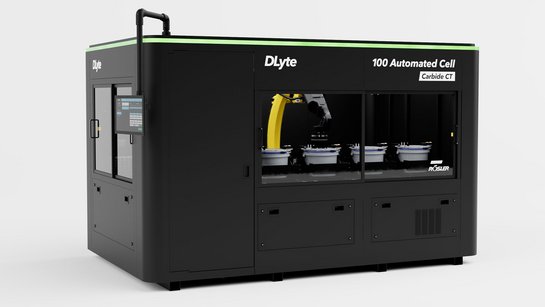
World premiere at the AMB trade fair in Stuttgart, Germany: With the DLyte Automated Cell Rösler Oberflächentechnik GmbH offers the first fully automated system for surface finishing of carbide cutting tools with the DryLyte technology. This innovative machine can simultaneously and fully automatically perform multiple surface treatment tasks such as cutting edge preparation, polishing or decoating work pieces. This is possible, because up to four different electrolytes can be used at the same time in the DLyte system. The machine was designed with the goal of easily integrating it into existing manufacturing lines. Please find out more about this groundbreaking improvement of the DryLyte technology for surface finishing of carbide components on the Rösler booth at the AMB trade fair taking place September 10 to 14 in Stuttgart (hall 5, booth 5C61).
Fully automatic shot peening of gear parts for E-vehicles
Shot peening has established itself in the automotive industry as an indispensable surface refinement operation. For this task a leading German automobile manufacturer integrated the indexing satellite table shot blast machine RST 200-S15 from Rösler into a new manufacturing line for gear components for E-vehicles. The customer decided to purchase the Rösler equipment, because he had excellent experience with machines of the same type regarding productivity, process stability and ease of maintenance. In the automotive industry shot peening is utilized to induce a compressive residual stress in, for example, gear components and, thus, extend the life span of the material. For this challenging task, the BMW plant in Dingolfing uses satellite table shot blast machines from Rösler, which have been precisely adapted to the customer’s technical requirements. Now, the highly adaptable RST 200-S15 equipment concept was implemented in a new manufacturing line producing gear components for E-vehicles.
Forge & Foundry, Part 4 – Selecting a Shot Blast Machine for Sand Castings
Building upon the information shared in our last Forge and Foundry Series post about sand casting, we now turn to the process of selecting and designing machines to specific sand casting operations. Selecting the right shot blasting machine for your process and work piece means understanding how the work pieces and machine will interact. Here are common questions Rösler receives when developing perfectly specified solutions for sand casting.
Rösler vertical shot blast machine for processing sheet steel
The blasting of large, pressure-sensitive sheet metal made of materials such as stainless steel is a special challenge in steel construction that sometimes requires a complete rethink. The solution can then be that sheets do not pass through the shot blasting system in a horizontal position but are blasted “standing up”. Vertical shot blast machines are then used. These pose very special challenges in terms of development and design, but also offer other advantages such as a more compact and shorter system design and the avoidance of abrasive accumulation and abrasive pressure on the sheet metal. Technically speaking, a vertical shot blast machine is simply a modified roller conveyor blast machine. An example of such a system - and the largest one built by Rösler to date - is the vertical shot blast machine for the Chinese steel producer TISCO.
Mirror finish for high-end forged wheels in less than 40 minutes
Forged aluminum wheels are not only characterized by their low weight, high stability and excellent load bearing characteristics but also by their exclusive optical appearance. Therefore, it is not surprising that manufacturers of luxury cars are primarily utilizing forged aluminum wheels in their vehicles. Optical highlights of the high-end automotive wheels are not only their attractive design but also their immaculate high gloss polish. To achieve such a perfect finish the wheels must undergo a surface grinding and smoothing operation before they can be polished. Treating the wheels with classical vibratory finishing methods or finishing them with costly manual labor requires several hours of processing time. A leading wheel manufacturer wanted to significantly reduce the time requirements for partially finishing already painted bicolor wheels and was looking for a suitable technical solution. This was found with the Rösler plunge finisher R 1/1 TSA-O/VS-So. The plunge finishing technology was developed by Rösler for the consistent and quick deburring, edge radiusing, surface grinding and polishing of complex, heavy and delicate components.
Structural Steel FAQ, Part 7 – Comparing Commonly Used Blast Machines
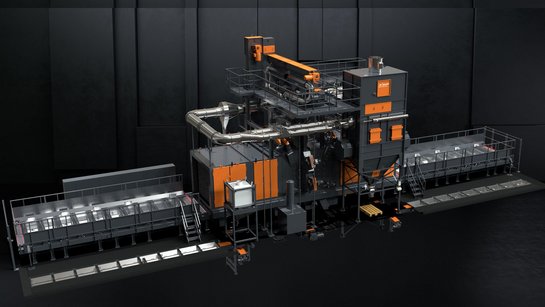
Steel construction and steel trade, shipyards and ship building, and heavy equipment and machinery building rely heavily on specially designed shot blasting machines to prepare their components. Rösler expertly designs shot blasting machines for these industries and others to descale, clean, and prepare structural steel for surfaces for end-use. The particulars of each machine largely depend on the size and shape of the specific components in need of preparation. This installment of our Structural Steel FAQ series will answer that question: What are the most commonly used blast machines for structural steel surface preparation and how do they compare?
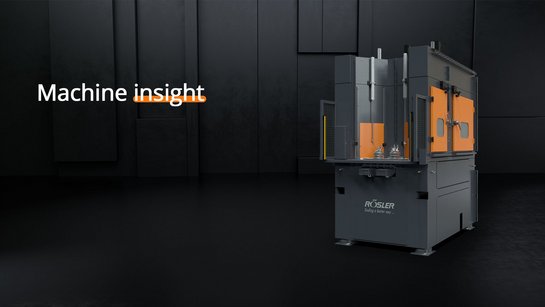
Machine Insight: RSA 1500 Indexing Satellite Table Air Blast System
Rösler’s RSA 1500 offers compressed air blasting technology in an indexing satellite configuration. This system is ideal for descaling, surface texturing, cleaning, deburring, de-sanding, creating homogeneous surface finishes, and shot peening.
Lower costs and higher productivity for shot peening processes
Shot peening, the “hammering” of work pieces with precisely defined blast media, is an indispensable operation in industries such as automotive and aerospace. By inducing a residual compressive stress into the work pieces, the shot peening operation substantially improves their long-term resistance against tensile and bending loads. The process is used for treating toothed, steering and transmission components, also for springs, drive- and crankshafts and all kinds of turbine blades. A significant advantage of the peening operation is that the component weight can be reduced without impacting its mechanical load capabilities. This is particularly beneficial in electric vehicles, because it increases their operating range and reduces their energy consumption. Due to changing work piece structures and shapes E-mobility frequently necessitates the alteration of manufacturing processes. Moreover, the customers are demanding significantly higher energy-, resource- and cost-efficiency. In other words, significant improvements in productivity and sustainability. Rösler can provide comprehensive support for such optimization projects.
Avoid Media Glazing to Prevent Process Inefficiencies, Breakdown
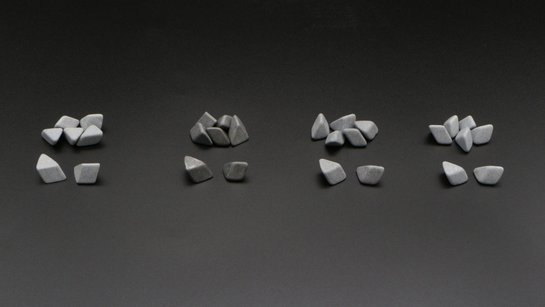
Media plays an essential role within a mass finishing process. Whether ceramic, plastic, if polishing or drying, optimal media mix and conditions must be maintained to produce precise finishing results. “Glazing” occurs when the surface of the media becomes contaminated with metal fines and other debris from the work pieces. As a result, the media becomes very shiny and frequently looks like a piece of aluminum, brass, steel, zinc, etc. Because glazed media completely loses its original surface properties, it no longer has any grinding effect. Instead, glazed media creates a sort of uncontrolled burnishing. It also retains dirt and other particles which are then deposited on the work pieces. The image above depicts (from left) media states include clean, heavily glazed, partially cleaned, and fully cleaned. Rösler has more than 60 years of media production experience. In that time we’ve seen—and corrected—countless examples of ineffective surface finishing as a result of media glazing.
Plastic deflashing Part 3 - Advantages and limitations of turbine and injection blasting
There are two main blasting processes available for deflashing plastic components, primarily made of thermoset and special thermoplastic materials: Turbine blasting, which is extremely effective over a large area, and highly efficient punctiform acting injection blasting. Both processes are also used in conventional blasting systems for metal processing. In contrast, plastic deflashing is a much gentler processing method, particularly due to the selection of non-abrasive blasting media. Which blasting process is selected for plastic deflashing depends on various factors. These include the production volume and the question of whether bulk material processing is possible or whether the parts are of a type that requires individual part processing. Another criterion is the question of whether the parts are to be partially or completely blasted and which blast media grain size and blast media speed are required.
Rösler becomes exclusive global sales partner for GPAINNOVA's DLyte Carbide Series for surface finishing of carbide cutting tools
Rösler Oberflächentechnik GmbH and the Spanish technology group GPAINNOVA are expanding their partnership: After Rösler has been the exclusive distributor of GPAINNOVA's DLyte Industrial Series for the German market for some time now, the world market leader Rösler will also take over the worldwide distribution of GPAINNOVA's Carbide Cutting Tools Series as well as the individual process development and service of the machines. In addition, GPAINNOVA is working closely with Rösler on the further development of the DLyte Carbide Series and the underlying DryLyte process.
Overcoming the shortage of skilled labor with smart shot blast solutions
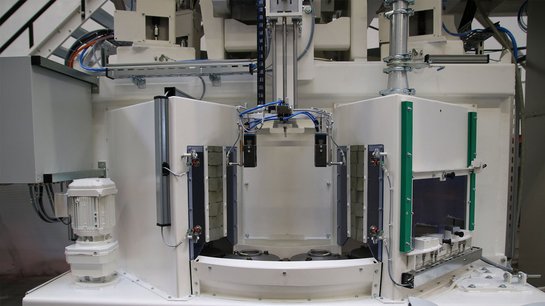
In many industrial sectors the pronounced shortage of skilled labor is an essential obstacle for sustainable growth. With clever automation and digitization of manufacturing operations this problem can be partially overcome. When it comes to shot blasting applications, Rösler offers excellent equipment concepts for indexing continuous flow manufacturing operations. One such machine is the compact RWK 6/12-2 swing chamber shot blast machine. Equipped with automated work piece handling it can easily be integrated into linked manufacturing lines, requiring very little space. In addition, the furnished digitization software package from Rösler Smart Solutions provides complete process and cost transparency and minimizes the overall personnel requirements.
«
‹
1
2
3
(current)
4
5
6
7
8
9
10
11
12
13
14
15
16
›
»