GKN Aerospace Relies on Rösler’s Mass Finishing and Shot Blasting Solutions for High-Precision Turbine Blade Processing
, Rösler Oberflächentechnik GmbH - Volver a la vista general
For decades, the area around San Diego (CA) has been a center for the US aerospace industry. It offers highly qualified personnel as well as a large network of suppliers. At the same time, the state of California is imposing strict regulations for sustainable and resource saving manufacturing. In 2024 GKN Aerospace, a globally leading manufacturer of high-performance components and systems for the aerospace industry, who supplies customers like Pratt & Whitney, General Electric and Boeing, opened an ultra-modern factory in El Cajon. This location specializes in MRO operations (Maintenance, Repair and Overhaul) for all kinds of aircraft components.
The high environmental protection standards in Southern California are in perfect synch with the sustainability offensive of GKN Aerospace. But for suppliers they can pose a real challenge: Every piece of equipment must comply with the strict environmental standards in the state of California. But in addition, it must offer precise, reliable and highly productive performance. For the relatively complex reconditioning of turbine blades for aircraft engines the customer chose high-performance surface finishing systems from Rösler, not only for stripping of the used turbine blades but also for the final mass finishing operation. To a large extent this decision was influenced by the positive experience the GKN Aerospace sister company in Malaysia had with comparable Rösler equipment and processes.
Innovative Rösler technologies – in perfect compliance with environmental standards
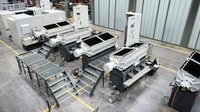
The blades in aircraft engines, be it fan blades, pressure blades or turbine blades, are exposed to tremendous stress, including high temperatures, strong centrifugal force and constant vibration. Over time, such loads can cause material fatigue, micro cracks and unwanted deposits. To ensure the safety, performance and efficiency of aircraft engines, the blades must be periodically checked, cleaned and as needed, overhauled. The required technical procedures are spelled out in the repair manual for the respective engine components issued by the engine manufacturer. It stipulates that prior to visual and x-ray inspection the components must be stripped of all coatings, respectively, deposits. For these stripping operations GKN Aerospace is using a high-pressure water jet system from Rösler that produces perfect results. Since it does not require any processing media or chemicals, the stripping process with pure water is extremely eco-friendly. A further advantage of the water jet system is the automatic process water cleaning and recycling system that drastically reduces the overall water consumption. The final step of the overhaul operation, surface finishing of the reconditioned components, is also handled by Rösler equipment, namely 12 tub vibrators. Two process water cleaning and recycling systems, each equipped with two centrifuges, are cleaning the process water contaminated with solids and sending the cleaned water back to the mass finishing machines for reuse.
A digital monitoring tool from Rösler Smart Solutions is continuously checking the quality of the process water. And in case of deviations from the set values it recommends corrective actions.
Effective and sustainable stripping with a high-pressure water jet system
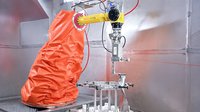
To allow an objective evaluation of their condition, in a first step any coatings/deposits on the blade surface must be removed. Until now, this was done using chemical stripping, which involved substances that had to be disposed of in a complex and costly process. At its sister plant in Malaysia GKN Aerospace has been using a Rösler high-pressure water jet stripping system for several years. Based on the good experience in Malaysia the plant in El Cajon decided to use the same stripping technology. „For GKN Aerospace we supplied a so-called ALS system, a robotic blast system equipped with a rotary table. Up to six turbine blades can be clamped on the table and are then processed, one after another,” explains Tobias Maaser, Sales and Project Engineer Shot Blasting, and as such exclusively working with customers from the aerospace industry. One stationary and one rotary nozzle ensure effective, all-around treatment of the titanium components. „The high-pressure water jet technology uses a combination of high energy in combination with a liquid medium, namely water. This penetrates the surface and chips away the surface coatings. Water jetting is much faster than the previously used chemical stripping method.” Actually, it is twice as fast and extremely eco-friendly, because it completely eliminated the disposal of numerous batches of chemical waste and coating residues.
The highly regulated aerospace industry requires not only effective and sustainable equipment technologies; equally important is the complete documentation of all manufacturing processes. The robotic stripping of the turbine blades is fully automated, and the entire process, including the computer managing the robot movements, is controlled by a supervisor system (PC supervisor master). The supervisor monitors all process parameters in real time, including all valves, maintenance components and processes. The entire process status is digitally displayed. Based on their serial numbers a barcode scanner assigns the respective processing program to the components, thus allowing complete documentation of every single process step. Because the PC supervisor monitors all process parameters and makes sure that their values remain within set limits, complete traceability of the entire process and, therefore, absolute process safety is guaranteed. This is particularly critical for shot blast processes, because one faulty operational parameter can damage or even destroy a component.
Ergonomic, precise finishing in tub vibrators with a minimum of resource input
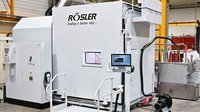
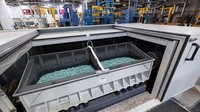
For another stage of the reconditioning operation at the El Cajon location, namely the surface refinement of overhauled turbine blades, the customer is also using a Rösler system. With this operation the savings in processing time and use of processing media are even more impressive. Until recently the last step, surface finishing of the reconditioned components, was done in somewhat obsolete machines, supplied by a competitor, and with comparatively low-quality processing media. „The finishing process as such is clearly prescribed, and we were not permitted to make any changes,” explains Michael Striebe, Global Sales Expert at Rösler, who is responsible for managing mass finishing projects in the aerospace industry. „However, we completely replaced the old finishing equipment and are utilizing our own high-quality processing media, with astonishing success: Through the higher efficiency of our tub vibrators and grinding media perfectly matched to the finishing task, we could reduce the media consumption by 30 percent. And processing times are 50 percent shorter than before.” But the new mass finishing vibrators are not only designed for high efficiency but also offer optimized ergonomics. Pairs of two tub vibrators share one pedestal. This shortens the distance the machine operator has to walk. For noise protection, a key consideration of the project, the mass finishing machines were completely enclosed with suitable noise absorbing cabins. In each tub, equipped with dividers, two work pieces can be processed at the same time without touching each other.
With a suitable supervisor system the entire finishing process is monitored and all process stages documented. The specified finishing goal is a surface roughness value of Ra = 0.6 µm (24 micro inches).
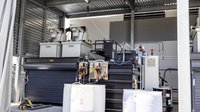
A big step towards improving the sustainability of the mass finishing operation is the switch from using fresh water for every single finishing cycle to cleaning and recycling the process water. For this purpose four fully automatic centrifuges were installed for cleaning the process water and pumping it back to the mass finishing system for reuse. Depending on the actual water demand one or two of these centrifuges can be turned on or off, in line with the “master & slave” principle.
Michael Striebe from Rösler comments: „Recycling of the process water had a real positive impact on the CO2 footprint of the entire mass finishing operation. With the twelve finishing vibrators the customer lowers his consumption of fresh water by roughly 1,500 liters every hour. The cleaned and recycled process water has a usable life of about three months, before it must be replaced. This is a real breakthrough for sustainability at GKN Aerospace, and we at Rösler are proud for having played a key role in this project.“ The process water cleaning & recycling system is controlled by the “Advanced” version of the Rösler Smart Solutions (RSS) software. This digital tool checks the condition of the process water and recommends corrective action, whenever predefined values of certain water parameters are out of the acceptable range. The comprehensive monitoring of the process water conditions resulted in additional savings in consumables consumption, especially the compound usage. Compared to the exclusive use of fresh water the process water recycling system helped reduce the overall compound consumption by around 90 percent.
One supplier, two surface treatment technologies: Rösler supplies total solutions
Salvador Jaimez-Meneses, senior manufacturing engineer at GKN Aerospace at the plant in El Cajon explains: „Rösler was chosen for the vibro and HP projects, because the company worked closely with our engineering team to develop solutions that are perfectly adapted to our requirements.“ He continues: „While other suppliers only offered standard equipment without consideration of our specific technical needs, Rösler provided professional support during the entire planning and validation phase. The Rösler engineering team was actively involved in adapting the blast and mass finishing machinery to our requirements, including optimization of the ergonomics of the vibratory tubs. The ergonomic improvements are based on a recommendation by our sister plant in Malaysia, especially, the people who are operating the machines. This active participation of GKN Aerospace personnel helped to ensure that the Rösler equipment fully meets our production requirements and quality standards.“
But it was not only the close cooperation with the experts at Rösler that convinced GKN Aerospace to choose this German supplier with its subsidiary company in the United States. The fact that Rösler was the only company that could offer high-pressure water jet blasting, mass finishing machinery as well as the required processing media and services from one single source, also played a key role. Salvador Jaimez-Meneses at GKN Aerospace concludes: „Throughout the entire project Rösler provided exemplary support. If we had to do it all over again, our preferred supplier would be Rösler.“