Cost-effective surface finishing of acetabular cups in a rotary vibrator - digitally controlled and highly precise
, Rösler Oberflächentechnik GmbH - Terug naar overzicht
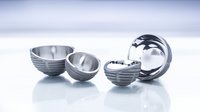
Most suppliers still prefer CNC-based technologies for grinding and polishing the internal surface areas of acetabular cups. However, a mass finishing process in a rotary vibrator, in combination with a specially developed clamping device, now represents a substantially more cost-efficient solution. The process is not only less costly, but it produces the required surface roughness values easily and consistently. Rösler Oberflächentechnik developed a 2-stage process that allows the simultaneous finishing of up to 35 cups. This became possible with a specially engineered work piece fixture.
Acetabular cups for „dual mobility“ use are generally made from cobalt chrome or titanium. They are produced with a milling process followed by a fine grinding or fine turning operation for smoothing their initial surface roughness. After this machining operation the Ra value of the raw components usually amounts to between 1.0 and 0.6 µm. However, before the cups can be implanted into the body, their surface must be significantly smoother. The maximum surface roughness readings cannot exceed Ra values of 0.05 µm. This ensures optimal functionality of the acetabular cup, sufficient coverage with lubricants produced by the body and prevents unwanted friction between the PE insert and the metal cup.
The challenge – grinding of internal surface areas
For this finishing task the special challenge is not the achievement of the required surface roughness values but the critical position of the surface area to be treated on the inside of a half-sphere. This represents a so-called “cup shape” that normally prevents the processing media to exert any significant pressure. If the work pieces were to freely tumble in the processing bowl of the rotary vibrator, the internal space of the work pieces would be filled with media. But effective grinding would only take place on the external surface. There would be insufficient “rubbing” between the media and the work pieces on the internal surface areas.
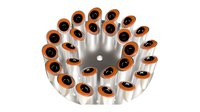
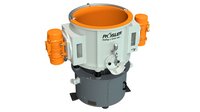
In this particular case Rösler was able to utilize its decades long experience in surface treatment, especially its profound knowledge of mass finishing and its in-house engineering and manufacturing capabilities. „The acetabular cups are finished in a rotary vibrator without inner dome. These machines were initially developed for the aerospace industry, where high-value, complex components must be finished gently with, at the same time, high metal removal rates. Compared to traditional rotary vibrators the processing bowl does not contain a vibratory motor in the inner dome but two motors on the outside of the bowl. This provides space in the bowl center for a clamping device with a unique inlay, in which the acetabular cups can be fixtured,“ explains Michael Striebe, Global Sales and Process Expert at Rösler. Clamping the work pieces allows the processing media to exert ample pressure on the inner work piece surface to make the grinding and polishing process highly effective. For the finishing process a plastic grinding media, specially developed for medical technology applications, and a dry polishing media are utilized. With the extremely fine structure of the grinding media very low surface roughness values of under Ra = 0.05 µm are achieved during the pre-grinding operation. The highly homogeneous and fine structure of the grinding media creates the perfect surface prior to the final polishing step. This reduces the surface roughness values further to a value 0.02 µm or lower.
The cycle times depend on the base material the acetabular cups are made of and the initial condition of the raw work pieces.
Mass finishing – a more cost-efficient alternative to robotic surface finishing
Robotic surface grinding and polishing of acetabular cups may be fast, but programming of the robot movements, process controls and wear compensation for the grinding and polishing tools for every single work piece type make it very expensive. With robotic polishing operations only one single work piece can be picked up and clamped. And each work piece size requires its own, exactly defined robotic program. Moreover, users must cope with considerable wear of the equipment, such as polishing tools, brushes or other special tools. Due to the wear of the tools the metal removal rate constantly changes. This must be considered when planning a robotic finishing process. Because it always makes the same movements, the robot itself cannot offset these wear rates. The same is true if the final polishing step is done manually. Manual polishing is also fast but prohibitively expensive. Fluctuating finishing qualities pose another risk with manual finishing because the operator cannot always maintain the same operating parameters. And finally, it is becoming extremely difficult to find experienced people for such grinding and polishing operations.
In contrast, all that is needed for a mass finishing operation in a center-less rotary vibrator, once the work pieces are clamped in the processing bowl, is the setting of the processing time. The rest is handled by the machine! The process requires no operator nor any additional automation tools. Only suitable grinding and polishing media, water and electrical power are used. Of particular importance is the fact that the wear of the grinding media does not affect the finishing results whatsoever. The only requirement is that the media level in the machine must be kept constant.
„All this results in a more consistent, repeatable and overall higher finishing quality with a more homogeneous structure,“ explains Michael Striebe, who, for the last 10 years, has been supporting customers from the medical engineering field in his role as Global Sales and Process Expert at Rösler: „My experience clearly indicates that the surface finishes generated with mass finishing have a fine structurer and a higher quality. We consistently achieve surface roughness readings that are lower than the specified values. Depending on the initial surface roughness of the raw work pieces, surface readings of Ra = 0.01µm are possible – without jeopardizing the dimensional tolerances for the work pieces. This extraordinary quality proves the efficiency and effectiveness of the mass finishing technology.“
Digitization allows effective process control and improves operational efficiency
Surface finishing operations for medical components, especially for orthopedic implants, demand not only high cost-efficiency as well compliance with the specified surface roughness values and the dimensional tolerances for the work pieces. Besides achieving absolutely consistent, high-quality finishing results, the entire process must be completely replicable in its design, its stability and its repeatability. And it must be completely documented. Comprehensive work piece and process monitoring is an essential pre-condition for manufacturing processes that are subject to validation and audits.
All these demands can be met with the latest version of the Rösler digitization software Smart Solutions Comfort (RSS). The digital software automatically monitors the process water quality, automatically takes water samples within defined time intervals, documents the measured values and corrects deviations from preset values by targeted dosing of chemical additives. This ensures stable process water quality. Furthermore, it significantly supports process repeatability and, thus, guarantees consistently high finishing qualities on the processed work pieces. Whenever the system identifies additional required actions, it informs the operator and issues precise, documentable action proposals. Any adjustments to the process are also documented and are completely traceable.
A solution for the future – tailored to medical components
With the development of this efficient grinding and polishing process in a center-less rotary vibrator Rösler offers an economic alternative to robotic and traditional manual finishing operations. The high manpower costs required for manual polishing can be reduced by 70 - 80%, because the only remaining manual operation is placing the work pieces in the rotary vibrator. Excellent surface qualities, absolutely repeatable results and the option for digital process monitoring and control with Rösler Smart Solutions software (RSS) qualify this process as an excellent solution for the precise surface finishing of acetabular cups. „When we developed the new process, we carefully studied the “pain points” of the systems available in the market and adapted our solution accordingly,“ explains Michael Striebe. „This was only possible by combining our competence in equipment manufacturing, process development and media & compound production, all done in-house! The future of acetabular cup finishing is in the center-less rotary vibrator.”