The versatile possibilities of surface finishing for firearms using mass finishing
, Rüdiger Böhm, Patrick Doliwa - 回到概览
The importance of surface finishing in firearms manufacturing
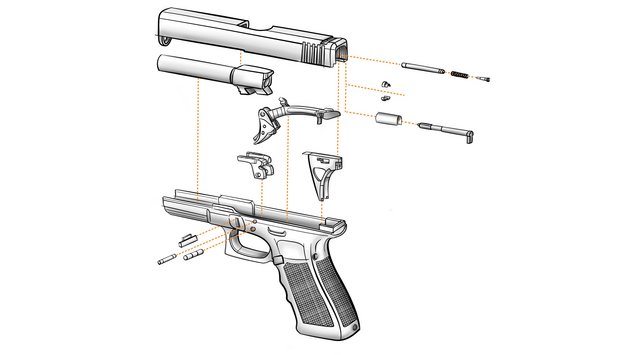
Surface finishing occupies a central position in the manufacturing of firearms. Many components, such as slides, frames, barrels, magazines, and small parts, are produced from steel or aluminum, typically by milling, and exhibit burrs, machining marks, surface roughness, and sharp edges after the cutting process. These must be removed or smoothed without compromising tight dimensional and form tolerances.
In addition to deburring and edge radiusing, the entire workpiece surface must also be improved. Particularly for high-quality hunting and sporting firearms, flawless, uniform surfaces are required. At the same time, the demands for precision and functionality must be reliably met.
Perfect, homogeneous surface structures are also required for downstream processes such as bluing on steel and cast iron materials, enabling uniform coloration and thus a high-quality appearance. Mass finishing likewise lays the foundation for these requirements.
Light metal parts must furthermore be prepared for anodizing, often hard anodizing, or other coatings through specifically adapted pre-processing surface finishing.
Requirements vary considerably depending on the firearms manufacturer, material, product segment, and intended use. While some manual processing steps are still required in production, the desire to automate manufacturing processes and increase reproducibility is growing, particularly at higher production volumes, such as in the defense and government sectors. In general, it can be noted that many manufacturers are currently working to optimize their production operations economically and increase output.
Initial processing by chemical mass finishing in rotary vibrators
The introduction of machine-based surface finishing of firearm components at Rösler began in the early 1980s with the Chemofinish process developed by Rösler, a chemically accelerated mass finishing method. Applied to steel parts, this process enables targeted material removal and surface smoothing without excessively rounding critical edges or altering important functional dimensions. To this day, numerous firearms manufacturers continue to rely on this approach.
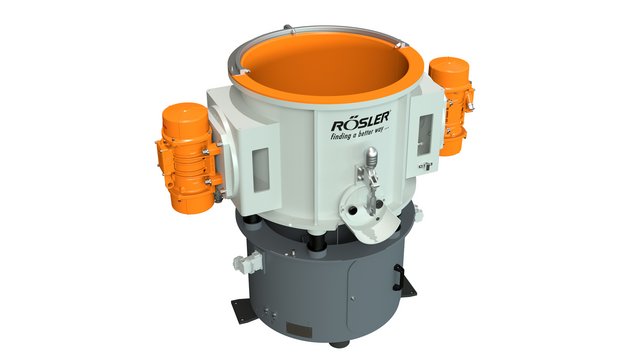
Processing is frequently carried out in rotary or tub vibrators, in which larger quantities of parts, sometimes protected by workpiece fixtures, can be finished. Typical workpieces include slides, frames, barrels, and other steel components. Alternatively, slides, frames, and other firearm components can be mounted vertically in workpiece holders for task-specific applications and processed in rotary vibrators without inner dome. For this purpose, the parts are clamped to a special workpiece fixture outside the mass finishing system and then inserted into the system. The workpiece fixture can be mounted to the magnetic tensioning system in the base area of the rotary vibrator. Damage caused by part-to-part contact is thereby eliminated.
This variant is an attractive solution when the process is to be automated using manipulators or robots that handle loading and unloading.
The individually used materials, manufacturer-specific production methods, and diverse workpiece geometries demand situationally adapted process solutions. We develop these solutions, supported by intensive testing carried out in our Customer Experience Centers.
Contactless mass finishing in Drag Finishers

In general, the typically complex-shaped, damage-sensitive precision components of handguns can, depending on their size and geometry, be processed without damage not only in vibrators but also in drag finishers.
High-precision parts such as the firearm frame, as well as the slide and barrel, require a mass finishing process during preparatory surface finishing that reliably prevents part-to-part contact. This is particularly essential for subsequent finishing operations such as hard chrome plating, bluing, nitrocarburizing, and similar processes.
The drag finishing process is particularly well suited in these cases. Firmly clamped in the workpiece fixture, even sensitive surfaces can be processed reproducibly and high-quality finishes achieved.
In addition, there is the high intensity of drag finishers, which often enables short process times. In combination with exactly matched precision tools, the grinding media developed and manufactured in-house by Rösler, it is possible to adapt the process to specific components. Plastic media are frequently used in drag finishing systems to achieve controlled smoothing and polishing processes. Depending on requirements, surface qualities can be achieved that are comparable to those known from medical technology. Particularly for premium or hunting firearms, this opens up the possibility of largely automating polishing operations that have previously been performed manually.
Furthermore, pH-neutral mass finishing processes can today almost always be implemented using process water circulation technology solutions. This greatly supports cost-effective machining as well as environmental and sustainability goals.
The drawback of this technology lies in the limited number of parts per processing cycle and the fixturing effort needed. Nevertheless, individual part processing offers significant advantages when the highest surface quality and maximum process reliability are required.
Processing in high energy disc systems
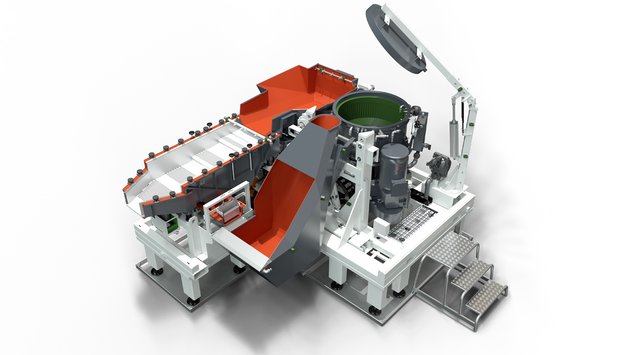
High energy disc systems are used primarily for processing smaller firearm components, including hammers, triggers, safety elements, and other precision parts.
These components must meet the same high surface quality requirements as larger parts. However, due to their geometry, they can often only be processed cost-effectively in high energy disc systems. The high relative motion between workpieces and grinding media results in short process times and efficient material removal.
Processing in tub vibrators
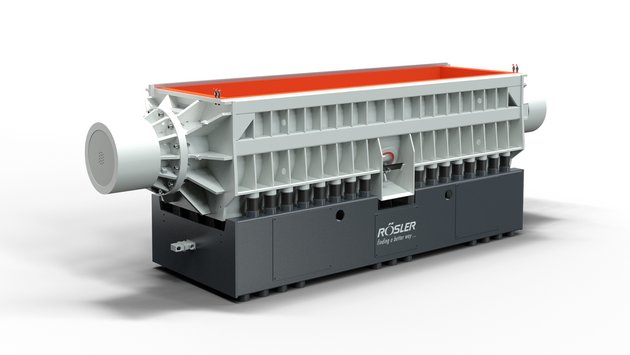
Tub vibrators are used primarily for oblong components such as gun barrels. Due to their geometry, such components can only be processed to a limited extent in other mass finishing systems.
The barrels are typically mounted on special fixtures capable of holding multiple workpieces simultaneously. This prevents the components from damaging one another. Both conventional paste-based grinding processes and chemically assisted processes are in use.
The processing of already-rifled barrels requires particular attention. In these cases, the drill holes must be sealed or masked reliably to prevent grinding media or process fluids from entering the interior. Even minor damage to the precision surface could affect the ballistic properties of the firearm.
Particularly for high-quality hunting firearms, which are still frequently grinded and polished manually today, processing in mass finishing systems such as tub vibrators offers considerable automation potential. However, modern process development enables surface qualities that, until a few years ago, could only be achieved by hand, not only in the surface finishing of hunting firearms, but also in the finishing of military rifles.
Conclusion
The surface finishing of firearms involves a wide range of processes and system concepts. However, a single, universal solution does not exist since each firearm component has its own requirements regarding geometry, material, surface quality and production volume.
At the same time, the surface finishing of firearms is not a static environment. New materials, evolving manufacturing methods, increasing quality requirements and new regulatory frameworks mean that existing processes must be continuously reviewed and developed further. Processes that proved their worth twenty years ago often still form the basis of modern machining concepts, but are continuously adapted to new conditions, whether through modified process chemistry, new grinding media or optimized system technology.
For this reason, Rösler takes a holistic approach, regularly reviewing every application. Our many years of experience in mass finishing form the basis of this approach, and our extensive testing and development capabilities allow us to meet specific customer requirements.
The result is forward-looking surface finishing processes that keep pace with the ongoing changes in the firearms industry.