Rising production volumes demand automated processes: shot blasting and mass finishing in military vehicle manufacturing
, Patrick Doliwa, Robert Städtler - Назад к обзору
Defense and dual use: established technologies entering new territory
Armored personnel carriers, main battle tanks, and specialized vehicles such as armored recovery vehicles and combat engineering vehicles must withstand extreme operational stresses. From the drivetrain and running gear to large-scale structural assemblies, every component contributes to the reliability of the overall system and to the safety of the crew – this calls for a perfect surface quality that meets the specific requirements: it is a decisive factor in resistance, service life, and functional integrity under the most demanding conditions.
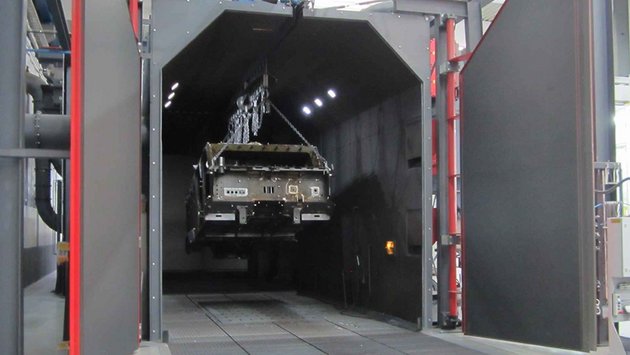
Shot blasting and mass finishing have long been integral to the production chain for armored and other military vehicles. Large welded structural components such as hull assemblies and turrets, as well as the outer surfaces of gun barrels, are shot blasted alongside running gear components such as track links, tank rollers, and drive wheels. Castings and transmission components are either shot blasted or mass finished depending on the specific requirements. Many of these applications are classic dual-use cases: the same systems and processes that have proven their worth over decades in commercial vehicle and mechanical engineering manufacturing and have been continuously developed further are equally well suited to processing components for armor-plated vehicles. A manufacturer capable of automatically shot blasting large welded constructions such as truck frames or tipper troughs already possesses, in principle, the technical prerequisites for comparable components in the defense sector. The same applies to mass finishing: transmission housings, castings, and engine components are workpieces well known from other industries.
What is new, therefore, is less the process itself than the combination of component size, geometry, required surface quality, and production volume. Defense investment over recent years has driven significant growth in production volumes, particularly across Europe, as evidenced by the order backlogs of major manufacturers such as KNDS and Rheinmetall. Output levels remain far below those of the automotive industry, however. As a result, demand is rarely for high-volume mass processing systems, but rather for flexible automation solutions designed for large, heavy individual parts. Nevertheless, the significantly increased demand requires manufacturers to substantially expand their production capacity while maintaining consistently high quality. A structural shift is also underway: for many years, manufacturers outsourced production steps and focused on final assembly. The deliberate move to bring these competencies back in-house is now generating considerable momentum in the market.
Shot blasting: automation for large weldments and castings

As long as hulls and superstructures for the defense sector were produced only in small quantities, surface preparation could in part still be carried out manually. When daily production volumes multiply, available personnel are no longer sufficient for this task – particularly given the significant physical demands of manual blasting. Automated systems reduce process times, deliver reproducible results, and relieve the burden on operators. For large welded constructions, the RHBD 35/35 K continuous feed spinner hanger blast machine is one suitable solution. It combines automated turbine blasting with manual touch-up blasting: blast turbines process large, readily accessible surfaces, while undercuts and hard-to-reach interior areas are subsequently partially hand-blasted as required. The objective is to completely remove mill scale and rust and achieve surface preparation grade Sa 2.5 in accordance with DIN EN ISO 8501-1 – the required foundation for a durably adhering camouflage coating.
Engine blocks, transmission housings, and other large castings in military vehicle manufacturing are often considerably larger than their automotive counterparts – the transmission of the Leopard 2 main battle tank, for example, occupies nearly an entire Euro pallet. For workpieces of this size, manipulator clamps with custom-fitted gripping jaws are used. These clamps handle parts weighing several hundred kilograms, introduce them into the blast chamber, and precisely rotate, pivot, and position them throughout the blasting process. This ensures that core sand is reliably removed even from complex internal geometries, that blast media does not accumulate in cavities, and that the entire surface is processed uniformly without shadowing.
Running gear components: cleaning and texturing
The running gear of tracked vehicles – typically main battle tanks, infantry fighting vehicles, or weapons carriers in the defense sector – also requires an optimized surface. Track links are shot blasted after the manufacturing process, which typically involves forming operations, in order to remove mill scale and rust and to texture the surface in preparation for subsequent process steps.
Track links are blasted individually and assembled into the track only afterward. The most suitable system depends on production volume: for higher volumes, a continuous flow installation such as the RMBD is the preferred choice; for smaller batch sizes, a spinner hanger blast machine is more appropriate. The same logic applies to tank rollers and drive wheels, where lot size determines the system concept.
Mass finishing of large individual parts: when standard systems reach their limits
In mass finishing as well, many processes established in the automotive industry can be transferred to the defense sector; defense customers in Germany and abroad have relied on Rösler systems for this purpose for many years. The equipment technology, however, differs considerably: whereas the automotive industry processes large quantities of smaller parts in high energy disc systems, the defense sector more commonly requires continuous flow installations for larger individual parts, as well as rotary and tub vibrators – for example, for deburring and smoothing, cleaning components, or removing light surface rust. Depending on the configuration, these systems can accommodate very large components, which can be separated from one another by dividers as needed.

One particularly demanding application is the processing of very large structural components in tub vibrators that can be fully automated using gantry cranes and loading robots. Rösler’s standard troughs are up to 7 meters in length. Component size, however, is only one part of the challenge – the forces acting on the trough during operation are the decisive factor. In a 7.4-meter tub vibrator, for example, the unbalance motors generate a force of up to 196,000 N (Newtons). This is equivalent to the gravitational force of around 20 metric tons, reversing direction 25 times per second. With the system operating in two shifts, this adds up to 360 million load cycles per year! In addition to an extensive standard range with various lengths, widths and drive concepts, application-specific custom troughs can be manufactured at any time to perfectly meet the particular requirements in terms of component size, weight and processing task.
The trough must therefore be designed not only for adequate load-bearing capacity, but above all for fatigue strength: under this alternating load, it must neither deform nor twist beyond permissible limits, and the weld seams in particular must not develop fatigue cracks. Furthermore, the longer the trough, the lower its natural bending frequency. This frequency must remain sufficiently above the excitation frequency to prevent the trough from entering resonance.
At the same time, the drives must be adequately sized and precisely coordinated with one another to set the entire trough into uniform, controlled vibration.
Conclusion: proven in civilian applications, in demand for military use

Whether large-scale welded constructions, heavy castings, or running gear components – shot blasting and mass finishing offer a wide range of capabilities for armored vehicle manufacturing. These processes have been proven in automotive and commercial vehicle production for many years. The task now is to adapt them to the component sizes and production volumes of the defense industry and, where dimensions demand it – as with XXL tub vibrators – to break new technical ground as well. The increase in demand is clearly perceptible and is in part a direct result of the expansion of in-house competencies at major OEMs: processing trials with large components for military vehicles were still the exception just a few years ago. Today, they are almost routine at our Customer Experience Center, where we work closely with our customers to develop solutions precisely tailored to the specific requirements of their components and industry – from the initial processing trial through to the fully automated production system.