Solution Finder
SOLUTION FINDER

您的罗斯勒产品世界指南

只需点击几下,您就能找到适合您的需求的机器!


结果: 237 文章
Multi-Tumbler RMT 70

Intelligent Multi-Tumbler solution produces absolutely consistent shot peening results on spring band clips

Quick, efficient and gentle processing of work piece batches A leading, globally active automotive supplier increases the tensile strength of spring band clips by shot peening. For this purpose the company purchased a second Rösler shot blast machine for its plant in Poland. The Multi-Tumbler RMT 70 shot blast machine, equipped with a highly wear-resistant Rutten high-performance turbine, was designed for fully automatic operation including loading and discharging of the work pieces. A simulation of the work piece behavior provided valuable design pointers making sure that in the actual barrel the work pieces are perfectly mixed. This guarantees the safe and gentle processing of the work piece batches and shortens the actual peening time. When it comes to developing and manufacturing of automotive components for lowering weights and reducing CO2 emissions, the worldwide active Mubea group is without any doubt one of the global leaders. The company’s products include components for automotive chassis, car bodies and drivetrains. Besides serving the automotive industry, the Mubea group also manufactures components and assemblies for aerospace and home appliances and offers custom-engineered solutions for other industrial applications. With over 700 different types Mubea also markets the worldwide largest range of spring band clips, generally known as hose clamps. More than one billion of these hose/pipe union connection elements are produced at locations in Europe, Asia and North & South-America. Simulation helps reduce the cycle time for peening of spring band clips To make these components, manufactured from high-strength alloyed tool steel, more resistant against the constantly changing loads in vehicles, their tensile strength is improved by shot peening them. For this purpose the Mubea Automotive Poland sp. zo.o. purchased a second Rösler shot blast machine. The Multi-Tumbler RMT 70 allows the fully automatic shot peening of spring band clips in batches weighing up to 1,800 kg. A key factor in the customer’s decision for this machine type was the unrivalled geometry of the blast barrel. A simulation of the work piece behavior in the blast barrel provided valuable design pointers making sure that the work pieces are perfectly mixed. This helped shortening the actual peening time. The unique barrel design also helped prevent any rejects by work pieces getting stuck and, thus, helped improve the overall productivity. High cost efficiency and reduced requirements for maintenance To comply with the strict specifications of Mubea Automotive Poland, the Multi-Tumbler is equipped with a Long Life Rutten blast turbine with curved throwing blades in “Y” shape and an installed power of 30 kW. The precisely calculated curvature of the blades generates an extremely high throwing speed along with a precise media guidance. This results in an optimal blasting efficiency. At the same time the turbine requires a lot less energy reducing the energy consumption by up to 25 %. The throwing blades are made from a highly wear-resistant alloy, and their special “Y” design allows using both blade sides. For this reason – depending on the used blast media – the Rutten high performance turbines achieve a 10 to 16 times higher uptime compared to conventional blast turbines. This results in a significant increase of the equipment availability and drastically lower costs for maintenance. An automation concept that is precisely tuned to the customer’s requirements To completely automate the shot peening process, the shot blast machine was equipped with a special work piece loading system that includes a weighing cell and the required software integration. This allows calculating the optimum batch weight during the automatic work piece load operation. The PLC adapts the shot peening time to the actual weight of the respective work piece batch. Throughout the peening operation the barrel is completely sealed with a lid. The barrel and turbine RPM are automatically adjusted with frequency inverters. All these features, combined with the optimum mixing of the work pieces in the barrel, make sure that absolutely consistent, repeatable peening results are achieved in surprisingly short cycle times. Of course, the continuous monitoring of all critical process parameters also contributes to the process safety and stability. The blast media recycling and cleaning system is adapted to the overall system and guarantees the consistently high blast media quality required for the shot peening process.

Wet Blasting Technology, Part 1 – Wet Blasting Gently Delivers Dramatic Finishing Results

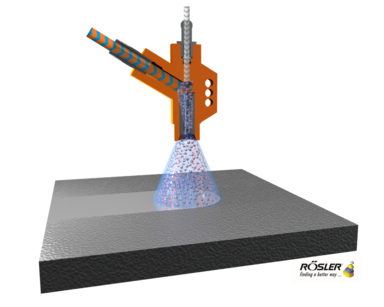
Thanks to its many technical advantages and “gentle” application, wet blasting is a versatile and fast-growing segment of the shot blasting field. Achieving precise, repeatable results with any wet blasting process requires understanding both its principles and real-world uses. With decades of experience and the latest in engineering expertise, Rosler understands how to develop efficient wet blasting machines and consumables . Learn more about wet blasting technology as we begin our five-part Wet Blasting Technology Series. How Does Wet Blasting Work? Wet blasting is a water-based method of shot blasting utilizing abrasives that are particularly suited for the finishing of delicate, precision-produced parts. Rosler Wet Blast Gun Schematic The blast medium consists of a slurry of water and an abrasive media placed in a tank. This slurry is supplied to the blast gun from the tank with a special pump and accelerated with compressed air. The compressed air creates a venturi effect at the blast gun nozzle. The accelerated slurry, pushed through the blast gun nozzle, is then thrown at the work pieces at high speed. The impact on the work piece surface creates the desired blasting effect, be it cleaning, coating preparation, cosmetic surface texturing, or peening. The concentration of abrasive media in the slurry usually amounts to 10-40% by volume. For example, 20% media and 80% water, etc. For consistent process uniformity and high-quality surface finishing of the work pieces, the control of the blasting nozzles in Rosler wet blasting machines is assumed by industrial robots or by CNC systems. Loading and unloading can also be automated in many ways, and the individual production requirements implemented. What is Wet Blasting Used for? Useful for any surface treatment task dry shot blasting is used for, wet blasting provides surface improvement, cleaning , preparation, decoating , preparation for initial coating, deflashing , and shot peening . Wet blasting is also ideal for stripping paint and coatings from delicate parts. High water content in the slurry allows wet blasting to be a lot more gentle than dry blasting. Therefore, it is ideal for processing delicate work pieces with thin walls, which, if treated with dry shot blasting, might be subject to heat warping. Wet blasting creates very smooth cosmetic finishes. To a certain degree, it can also be used for cleaning of work pieces contaminated with oil or grease, for example, for engine and transmission re-builds or aircraft MRO work . Wet blasting has also become indispensable for initial surface smoothing of additively manufactured components made from plastic and metal. Special surface finishes can be achieved by selecting different blast media materials such as ceramic beads and other mineral abrasives. In addition, the wet blasting process eliminates the risk of dry dust explosions and can ensure that you are meeting more stringent hazardous dust exposure limits. The Rosler Way With more than 80 years of experience in surface finishing, the Rosler team has expertise in the wet blasting field. To demonstrate our capabilities, we offer FREE sample processing in our global test centers . Contact us to discuss your wet blasting goals and challenges. The complete Wet Blasting Technology Series includes: Part 1 – “Wet Blasting Gently Delivers Dramatic Finishing Results.” Part 2 – “Comparing Attributes, Advantages to Dry Blasting.” Part 3 – “Technical Features, Slurry Control Achieve Precise Finishing.” Part 4 – “Typical Wet Blasting Applications.” Part 5 – “PureFinish® Offers Food-Grade Excellence.” Sign up for enews alerts to be notified of all Rosler blog posts!
Semi-automatic cleaning centrifuge RZ 120 M-V

Dewatering of paint sludge with centrifuges

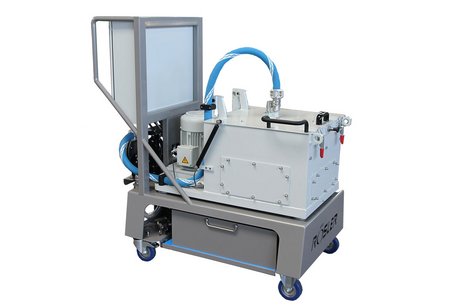
90 % cost reduction combined with a positive environmental impact Wet absorption systems are the standard method to catch and discharge overspray from paint booths. For dewatering of its paint sludge a Polish paint shop purchased a cleaning centrifuge from Rösler. With sizable cost savings this investment paid for itself within the first year of operation. At the same time the dewatering of the paint sludge by centrifuge saves resources and is more eco-friendly In 1996 the painting job shop Hannex, located in Ordzin, Poland, started with the manual wet painting of components for household appliances. Since then the company has developed into a sophisticated operation with modern work places for manual paint applications as well as several fully automatic painting lines equipped with 6-axis robots and computer controlled paint supply systems. The company is coating metal, plastic and glass components with solvent- and water-based wet paint materials. Krzysztof Iwanicki, general manager at Hannex, explains: „Besides the household appliance industry our customers also include automobile companies and their suppliers around the world. A focus on costs and the environment To ensure top quality and cost efficiency, the company utilizes the latest paint application technologies from renowned suppliers. This helps reduce overspray but does not prevent it completely. The catching of the paint mist takes place with the classic Venturi wet absorption method. This uses atomized water to pick up the excess paint particles in the paint booth and discharge the paint/water mixture into three collecting tanks with a total volume of ten cubic meters. To maintain the stability of the process water various chemicals had to be added for controlling the pH value, for defoaming and for protection against bacteria infestation. The addition of coagulants and flocculants made sure that the paint particles were separated from the water and floated to the surface. The resulting sludge was then removed from the surface and pushed into a separate container with a sludge scraper. Subsequently, it was disposed of. On average about 4 tons of sludge and dirty water accumulated per week. The professional disposal of this waste material was not only extremely expensive, but under environmental aspects the resulting high consumption of fresh water was not very eco-friendly. Last-but-not least, this paint sludge disposal system also caused an unpleasant odor, a real nuisance for the employees. Krzysztof Iwanicki continues: „These disadvantages had annoyed me for quite some time. Therefore, I became very interested in paint sludge dewatering with a cleaning centrifuge and was grateful to Filip Kapela, the representative of Rösler Oberflächentechnik in Poland, informing me about this possibility in 2016”. After this first information a joint visit at the headquarters of the equipment manufacturer was arranged. During his visit Krzysztof Iwanicki was able to acquaint himself with the working principle and the performance characteristics of centrifugal filters for paint sludge dewatering. The general manager remembers: „I immediately specified my requirements and subsequently decided to purchase a centrifuge RZ 120 M-V”. Efficient separation of solids and water from the paint sludge The semi-automatic cleaning centrifuge can handle a volume of 120 liters per minute. A feed pump continuously feeds the process water into the centrifuge drum, rotating at a speed of 2,750 RPM. The high rotational speed ensures not only an excellent performance in terms of throughput, but it also ensures that very small and light-weight particles are deposited on the drum wall as solid sludge with a residual water content of 20 to 30 %. This represents a significant improvement over the sludge scraper with the residual water content of the sludge amounting of more than 80 %. Once the sludge load in the drum has reached about 22 kg, the sludge can be easily removed by simply extracting the sludge basket out of the drum and dumping the sludge into a waste container. Alternatively, in fully automatic centrifuges the sludge can be removed from the centrifuge drum with a stationary peeling knife. During the separation cycle this peeling knife is positioned in the center of the drum. For sludge peeling mode the knife moves slowly towards the drum wall by way of a pneumatically activated linear guide. The peeled out sludge falls into a container placed below the centrifuge drum. This peeling knife arrangement prevents any additional load on the bearings of the rotating drum. After completion of the peeling cycle the drum is automatically rinsed out for removal of any residual sludge deposits, which, during the subsequent cleaning cycle could cause an imbalance with the risk of premature bearing failure. The cleaned process water, now free of paint particles, is fed back into the process with a special water collection tube. Quick amortization combined with high cost savings Because of its small footprint Hannex decided to purchase a semi-automatic centrifuge. The RZ 120 M-V is equipped with sophisticated controls and a process water and clear water tank. It is not only easy to operate and maintain, but because of its placement on a movable base, it can be easily utilized at the different collecting tanks. Krzysztof Iwanicki explains: „The centrifugal cleaning process is so effective that we no longer need any coagulants and flocculants for supporting the separation of the paint particles from the water. We could also eliminate all the other chemicals for stabilizing the process water in the collecting tanks. As a matter of fact, we are only using chlorine for disinfecting the reclaimed water coming out of the centrifuge in crystal clear condition”. But the savings by no longer having to use chemicals are not the only reason for the substantial cost reduction. Because of the drastically decreased residual water content the amount of paint sludge that must be disposed of has become a lot smaller. And finally, a lot less fresh water is required for the collection of the overspray paint mist. Krzysztof Iwanicki concludes: „The centrifuge has been in operation since 2016. It amortized itself already within the first year. And we could reduce the operating costs for paint sludge removal by roughly 70 %. Beginning with the second year of operation our annual cost savings increased to 89 %”. Besides the sizable cost reduction Krzysztof Iwanicki is also very pleased with the much lower consumption of resources and the positive effect on the environment. This undeniable success prompted him to purchase a second centrifuge for cleaning the water that is used for the general cleaning of the paint booths at Hannex.
Blades with patented Y-Design

Special turbines for shot blasting in the forge and foundry industry

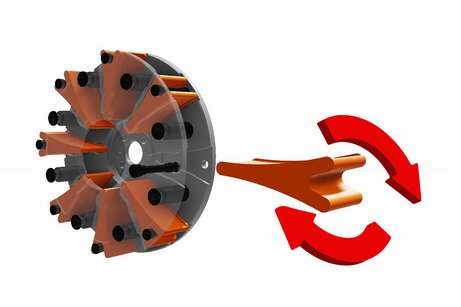
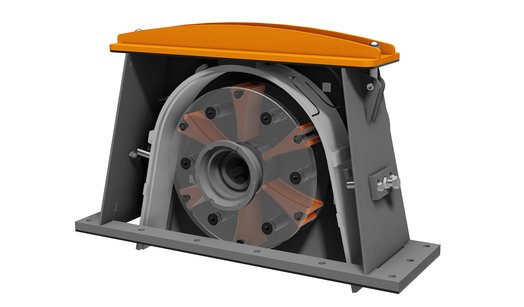
30 percent longer service life and lower operating costs The special version of the easy to maintain Rösler blast turbines Gamma 400G-8 has been perfectly adapted to the harsh blasting conditions in foundries and forge shops. Designed with 8 throwing blades and made from extremely wear resistant tool steel, the Gamma 400G-8 turbines offer an up to 30% longer service life than conventional turbines. Moreover, the Y-design of the throwing blades ensures a more effective and energy efficient acceleration of the blast media. This results in lower operating and maintenance costs combined with a significantly higher equipment availability. Sand, oxide, scale and residue from the tempering process on castings and forgings inevitably cause the blast turbines to wear a lot faster and lead to higher operating and maintenance costs. Rösler Oberflächentechnik GmbH has tackled this problem head-on by developing the Gamma 400G-8. This turbine variant is especially wear resistant and offers the ideal solution for such challenging shot blasting applications. It can be easily installed in all turbine shot blast machines irrespective of the original manufacturer. Equipped with a power input of up to 37 kW, the direct drive Gamma 400G-8 turbines allow a blast media throughput of up to 460 kg/minute. 8-bladed wheel design and tool steel guarantee a longer service life A key feature of these special turbines is the 8-bladed wheel design ensuring a greatly improved blast pattern. In addition, the forged throwing blades, impeller and control cage are made from high-quality, extremely wear resistant forged steel. Likewise, the turbine housing is lined with the same material. Compared to conventional turbines, this results in an up to 30% longer service life. And the patented Y-design of the blades allows using both blade sides, which practically doubles their usable life. An innovative quick-change system allows a quick and easy blade change without having to touch the other turbine components. The time consuming dismounting of impeller, control cage and inlet tube is no longer necessary. Improved performance and higher energy efficiency Another advantage of the Y-design with the precisely calculated blade curvature is a considerably better performance that expresses itself by a significantly higher throwing speed and a highly precise blast media delivery. The resulting improvement of the blast performance requires much shorter cycle times. Finally the energy efficient blast media delivery reduces the energy consumption by up to 15%. All these features uniquely qualify the custom-engineered Gamma 400G-8 turbines for use in foundries and forge shops. They offer a tremendous potential for not only reducing the operating and maintenance costs but, at the same time, increasing the shot blast capacity and overall cost-efficiency.

Mass Finishing Media, Part 2 – Tips for Measuring Media-to-Work Piece Ratio

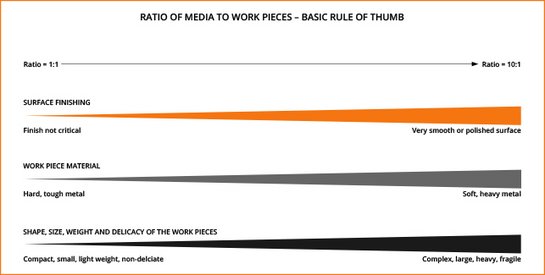
Maintaining the right ratio of media to work pieces is essential to achieving precise, repeatable results in mass finishing processes where work pieces and media loosely tumble in the processing bowl. Ensuring that the work pieces are properly embedded in the media allows the media to perform its designated grinding or polishing function as well as cushioning the work pieces from damage caused by part-on-part impingement. Building upon our last post on the series about navigating the complex media selection considerations , Rosler’s team of experts now discusses tips for determining the best media-to-work piece ratio. Basic Rule of Thumb The standard ratio of media to work pieces is around 3-to-1 by volume – meaning that the mix is 3 parts media to 1 part of work pieces – but the exact ratio varies based on the aggressiveness of finishing required as well as the work piece’s material, shape, size, weight, and delicacy or lack thereof. For simple, sturdy work pieces, the ratio may be lower than the standard while work pieces that are very delicate; made from soft, heavy metals; or must receive a high-gloss polish require a much higher ratio of 10-to-1 and higher. Typically, media-to-work piece ratios increase with the more extreme smoothing and finishing, higher material softness, large and heavy work pieces, and those with more complex or fragile construction. The basic rule of thumb for the ratio of media to work pieces in mass finishing. Pinpoint Your Ratio Determining the exact ratio for your mass finishing process requires digging a bit deeper into your specific media and machine specifications. Determine the “usable volume” in cubic feet of the processing bowl. This information is usually supplied by the equipment manufacturer. Determine the number or weight of work pieces that fit into 1 cu ft, e.g. for small parts use a 12x12x12” shipping box and transfer parts until the box is full. Use the bulk density of the specific media type to calculate the required media quantity by weight. For reference: Ceramic media = 95 - 105 lbs/cu ft Porcelain and high density media = 115 - 145 lbs/cu ft Plastic media = 70 - 85 lbs/cu ft An Example The usable volume of a processing bowl is 12 cu ft and the desired ratio is 5-to-1. Therefore, 10 cu ft of media and 2 cu ft of work pieces should be filled in the machine. We’ve determined that 50 work pieces fit into 1 cu ft so you would place 100 work pieces into the machine. If we were dealing with small, bulk goods, we would measure out 2 cu ft instead of counting individual pieces. Let’s assume we’re using ceramic media which weighs around 100 lbs/cu ft. Because we need 10 cu ft to balance out the work pieces, we will need 1,000 lbs of media. If we were using plastic media, the total would be around 750 lbs; high-density media would require about 1,400 lbs. Process Observation Once established, the initial media-to-work piece ratio must be constantly monitored. If the ratio becomes too low, new media must be added. Equipment updates may be available to help maintain the optimal media levels. For certain applications, timer- or widget-controlled media replenishment systems may be beneficial. The Rosler Way From the engineering of a mass finishing machine all the way through process refinement and service , Rosler partners with you to achieve precise and efficient results. Contact us for help with all aspects of your surface finishing process. The complete Mass Finishing Media Series includes: Part 1 – “Don't Navigate the Complex Selection Process Alone.” Part 2 – “Tips for Measuring Media-to-Work Piece Ratio.” Part 3 – “Why Discharging Undersized Media, Maintaining Media Levels are Crucial.” Sign up for enews alerts to be notified of new posts!
HP Jet Fusion 5200 3D Printing System

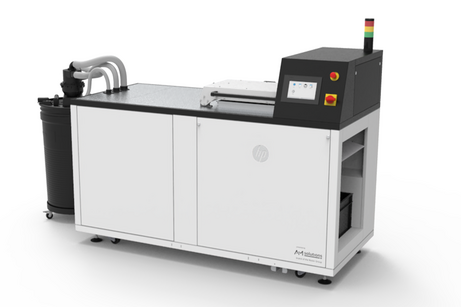
HP and AM Solutions Present the Innovative HP Jet Fusion 5200 Series 3D Automatic Unpacking Station

With the HP Jet Fusion 5200 Series 3D Automatic Unpacking Station, HP and the Rösler brand AM Solutions – 3D post processing technology, present their first product that was jointly developed on the basis of their cooperation agreement announced last year. This scalable, industrial post processing solution allows the fully automatic and consistent unpacking of AM parts made on the HP Jet Fusion 5200 3D Printing System in a continuous workflow. Compared to manual unpacking operations, the new solution offers not only a significant productivity increase and a greatly improved cost efficiency, but also a considerably higher powder reclaim rate for certain geometries. The Automatic Unpacking Station will be manufactured at the German location of the Rösler brand AM Solutions – 3D post processing technology. As a global leader in the field of industrial 3D printing solutions and digital manufacturing, HP recognized early on that the use of 3D printing on an industrial scale is only possible, if the printing and post processing operations can be combined into one automated, scalable process. About one year ago HP and AM Solutions – 3D post processing technology, a division of Rösler that specializes in post processing solutions for 3D printed parts, announced a cooperation agreement. This created the ideal foundation for developing such an integrated, industrial solution. The HP Multi Jet Fusion technology offers the possibility for volume production on an industrial scale. On the other hand, post processing still requires a great deal of manual operations. This is now changing with the innovative Automatic Unpacking Station for the HP Jet Fusion 5200 series. This unpacking station, the first result of the cooperation between HP and AM Solutions – 3D post processing technology, combines the full range of print, software and material knowhow at HP with more than 80 years of experience in the fields of surface treatment and equipment manufacturing for industrial applications at Rösler. Consistent, repeatable unpacking and a high powder reclaim rate The automatic unpacking process takes place immediately after the cooling of the build job in the HP Natural Cooling Unit. A lifting device is used to transfer the cooling unit to the Automatic Unpacking Station. There it is positioned, unlocked, and the entire build job is placed in the station. All relevant printing job data are transmitted to the unpacking station by means of its RFID reader. This ensures that the job- and process-related data can be tracked and the process monitored remotely by means of HP’s 3D Center software. Furthermore, the automated unpacking process, adapted to the individual work pieces, allows a considerably higher powder reclaim rate for certain geometries. An air suction system transfers the powder collected in the station continuously to a dedicated external tank. The printed parts are discharged into an unloading box. Once the external tank is full, it is replaced with an empty one, and the retrieved powder can be loaded back into an HP Build Unit after connecting the full tank to the Processing Station. The new Automatic Unpacking Station minimizes not only manual operations but also reduces the overall cycle time for certain applications, as the unpacking operation can start right after the recommended minimum cooling time is completed. Ramon Pastor, GM and Global Head of HP 3D Printing & Digital Manufacturing explains: “New solutions for the scalable, efficient post processing and automation of the entire workflow are the precondition for fully exploiting the advantages of Additive Manufacturing and making it suitable for industrial volume production.” Pastor continues: “With Rösler/AM Solutions we have found a partner who is intimately familiar with the standards of a broad range of industries and possesses the required knowhow in the field of surface treatment and equipment manufacturing.” Stephan Rösler, President & CEO of Rösler Oberflächentechnik GmbH, adds: “The comprehensive knowledge of HP in the areas 3D printing, software and digitized manufacturing allows us to quickly develop innovative solutions for the 3D post processing and adapt these solutions to the demands of industrial users.” This premise is fully confirmed by Matteo Rigamonti, Founder at Weerg: “The HP 3D Automatic Unpacking Station has fully met our expectations for an automatic unpacking solution. With a growing fleet of HP Jet Fusion 5210 systems at high-volume production, the unpacking process requires a lot of time and resources. Thanks to this solution, our unpacking process became not only significantly faster, but we are also reclaiming more powder. The process is precise, and works well even for small and delicate parts.” The company, a leading industrial parts provider located in Scorzè, Italy, produces around 2,500 pieces per day and has thoroughly tested the new machine at their facilities during numerous trial runs. Matteo continues: “As we expand our business, these enhanced capabilities are designed to help us meet customer demand, and improve our turnaround times, for high volume production parts.”

Automotive Supplier Achieves Process Stability, High Cost Efficiency with Modular Shot Peening System

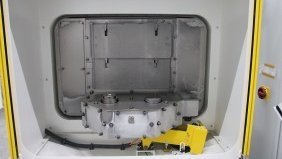
For transmission components like gears and shafts, shot peening has become an indispensable step in the overall manufacturing process. With the RWT swing table machine, Rosler developed a modular equipment concept that can be easily adapted to different technical requirements and offers a maximum in process stability paired with absolutely repeatable peening results and high cost efficiency. One of the numerous customers within the automotive industry utilizing the RWT is an Asian automotive supplier. The Need As part of a capacity expansion for minivan transmissions, this customer increased annual production to 40,000 units and decided to carry out the required shot peening operation in-house instead of subcontracting it to an external job shop. The specifications called for a system that can handle around 560,000 single work pieces per year, including 15 different types of gears and shafts. Each work piece type required the development of a specific peening program based on drawings and various work piece materials. Another requirement was the tight control of the entire peening process capable of handling gears and shafts with diameters of 12 in (300 mm), heights of 20 in (500 mm), and weights of up to 55 lb (25 kg). The Solution The customer chose the Rosler shot peening system RWT 13/4 So due to its capability and fully automatic processing. This pressure blast system includes a table with two 180° segments, each equipped with two satellite stations which allows two parts to be processed in one segment while another pair of parts is loaded/unloaded in the other segment. For complete coverage of the work pieces, the RWT is equipped with four blast nozzles – two for vertical and two for horizontal movement. Since some areas of the work pieces are completely finished before entering the machine, special wear-resistant masking is integrated into the work piece fixtures to protect the already finished surface area from being blasted. To meet all customer requirements, the system design allows the parallel use of two different blast media types or one type with different shot sizes. Rosler tested various work pieces during the course of the project. Rosler’s global test centers and the in-house X-ray diffraction measurement capabilities showed that the achieved compressive stress values were twice as high as the values stipulated by the customer. The in house X-ray diffractometer allowed Rosler to shorten the process development cycle for these transmission components. The measurement system can also be used for a variety of other parts besides gears and shafts. These can include valve and chassis springs, other chassis components, airplane turbines , and components for the energy generating industry. Rosler also offers x-ray diffraction measurements as a service . Developed for Success The RWT’s concept can easily be adapted to specific customer requirements since its swing table design is based on a modular concept developed for shot peening of rotationally symmetrical components. The RWT's blast chamber Compared to other peening systems on the market, the blast chamber contains considerably more wear protection and is easier to access for maintenance work. The pressure blast system requires a considerably lower amount of compressed air and, therefore, runs more efficiently. The RWT's monitoring and control system A comprehensive monitoring and control system measures the air volume to ensure the high process safety and consistency required for any shot peening operation. The RWT's blast nozzles The nozzles can be moved vertically and horizontally as well as pivoted at an angle from 0 to 90°. This guarantees complete coverage of all work piece surface areas over a large part size variety. The high efficiency of the pressure blast system results in significant savings in compressed air consumption. For controlling the overall peening process Rosler also uses standard components. These include the automatic control of the blast media throughput and the precise measurement of the media throwing speed directly at the nozzle exit. The Magna valves for precise dosing of the blast media as well as all media hoses can also be monitored. The RWT can be equipped with a spiral separator for discharging any broken-down blast media. The Rosler Way With more than 80 years of experience, Rosler has the knowledge and expertise to find the exact shot peening machine to meet your needs. Contact us to discuss your challenges and be sure to sign up for enews alerts to be notified of new posts! https://vimeo.com/142621047

Blast equipment modernization and upgrade – an efficient alternative to buying new

Turbine replacement results in a 45% higher blast performance and lowers operating costs by one third Growing maintenance and operating costs combined with a declining blast performance; these are usually good reasons for investing in a new shot blast machine. By taking advantage of the Rösler Retrofit program for a shot blast machine in its foundry division a leading company for drivetrain technology and electronic controls chose a significantly less expensive but highly effective alternative. The existing shot blast machine was upgraded with the foundry version of the Rösler Gamma 400G-8 high performance turbines. This turbine upgrade helped reduce the expenses for maintenance by two thirds and the overall operating costs by more than 34%. At the same time, the blast performance could be increased by 45 percent. This resulted in an amortization time of a little over one year. The turbines in shot blast machine must carry a heavy load and are exposed to a lot of stress. Over time this leads to ever increasing maintenance and operating costs along with a growing energy consumption. Frequently, the blast performance no longer meets the capacity and quality demands. In order to fulfill their shot blasting requirements in a cost-efficient and competitive manner companies usually invest in a new shot blasting system. A persuasive modernization solution with a quick amortization A renowned manufacturer of drivetrains and electronic controls was facing exactly this problem with a shot blast machine in its foundry. The responsible project managers at the company contacted TuneUp, a division of the Rösler Oberflächentechnik GmbH, that specializes in the modernization of shot blast equipment . On this occasion they learnt that the Rösler modernization and upgrade service covers not only Rösler equipment but extends to third-party machinery as well. After a comprehensive analysis of the current equipment condition the Rösler Retrofit experts presented a suitable technical solution along with a realistic amortization calculation. The customer was impressed by the technical depth and short pay-back period of the proposed modernization concept. Turbine replacement increases productivity and lowers costs At the center of the modernization concept was the replacement of the two 22 kW turbines originally supplied with the shot blasting machine. The existing units were exchanged with high performance Gamma 400G-8 turbines in wear-resistant foundry version, also with a drive power of 22 kW each. They are equipped with eight curved throwing blades in „Y“-Design with a precisely calculated curvature. This generates an extremely high throwing speed along with a precise media guidance and results in an optimal efficiency. The unique characteristics of the Gamma turbines with a 45% higher blast performance allowed achieving the needed capacity increase. Another feature of the new high performance turbines is that they require a lot less energy. The energy savings were an important reason for the overall operating cost decrease of 34%. Expenses for maintenance reduced by over two thirds The unique design of the throwing blades produces not only a higher performance but allows using both blade sides by simply turning them around. Depending on the utilized blast media, this design feature, combined with the use of wear resistant blade material, for example, forged tool steel, results in a three times longer lifetime compared to conventional turbines. An innovative quick-change system allows easily and quickly changing the blades at the mounted turbine. The usually required time-consuming dismounting of impeller, control cage and infeed pipe is no longer necessary. Overall this reduces the expenses for maintenance by more than two thirds. Quick amortization produces a competitive edge Based on the capacity utilization to-date, the productivity increase achieved by the upgrade and the cost savings the Retrofit investment will have paid for itself already after 1.1 years. The technical features of the modernized shot blasting machine and the quick amortization allow the user to improve his profitability and consolidate and expand his competitive position in the market.

Mass Finishing Media, Part 1 – Don’t Navigate the Complex Selection Process Alone

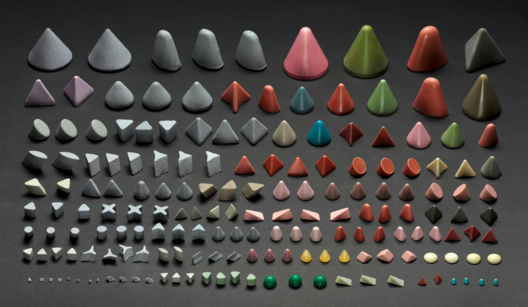
The importance of the media selection in any surface finishing process cannot be emphasized enough. These consumables are essential “precision tools” for achieving the specified finishing results. Selecting the right media is a complex task. That’s why you should consult an expert such as Rosler for guidance. Even after a mass finishing process has been established, the media status must be constantly monitored and, if necessary, corrected. When different work pieces are processed or finishing tasks are altered, exchanging the currently used media type with another may be required. Careful and collaborative media selection is crucial to a mass finishing success. Consider the Characteristics The work pieces should always be at the center of the media selection process and take into consideration its starting surface burr condition, material, shape, size, and desired surface finish. Media characteristics must complement the work piece as well as the machine being utilized. Media characteristics to consider in relation to work pieces and the machine utilized include: Bond – Ceramic media generally has a higher density than plastic media , making ceramic more aggressive. While typically more gentle, plastic media can sometimes produce unwanted foam known as “dirt foam.” Type/Abrasiveness – Deburring/edge radiusing and/or aggressive surface grinding require a more abrasive media than gentle surface smoothing. Shape – Media may have to reach very tight corners and internal passages. Choosing the right media shape is crucial for reaching all critical surface areas. Size – Always choose the largest possible media that fulfills the finishing tasks for the most efficient process. Lodging issues – Media lodged in the work piece can have disastrous consequences for downstream manufacturing. Selecting a media shape and size that prevents lodging is crucial. Color – Choosing a media color that differs from the work pieces helps identify lodging issues. Potential for damage – For delicate work pieces, gentle yet effective media must be selected to avoid bending thin walls or damaging critical sealing areas requiring a tight fit. Separation – Reliable media separation from the finished work pieces must be allowed by screens, inverse screens, magnetic separators, or, in extreme cases, manual separation. Intensity – More intensive machines such as centrifugal disc systems or drag finishers usually require smaller, less abrasive media than vibratory models such as rotary and tub vibrators . Analyze Ongoing Costs Since finishing media is a consumable that wears and must be regularly replenished, cost is an ongoing concern. In some finishing process, the expenses for media account for more than 50% of the total process costs. Therefore, it is important to select a media that is both economical and effective to maintain a viable mass finishing process. While media costs also play an important role in the selection process, media choice should never be determined by price per pound. Instead, the media cost per work piece should be a guiding factor. For example, a lower priced media might require much longer processing times or wears a lot faster and would therefore be less economical than a higher priced media that achieves the desired finishing results in less time and has a lower wear rate! Rosler Testing Center Partners in Testing Whether your process uses ceramic, plastic, or drying and polishing media , a crucial step in selecting media should always be contacting the experts, i.e. your supplier. Since a media change might require extended test trials, your supplier should partner with you to test prospective media with your specific work piece in their test lab. The Rosler Way With more than 80 years of experience in surface finishing, the Rosler team is well equipped to prove media selection guidance. We also offer FREE sample processing in our global test centers . Contact us for all of your mass finishing needs! The complete Mass Finishing Media Series includes: Part 1 – “Don't Navigate the Complex Selection Process Alone.” Part 2 – “Tips for Measuring Media-to-Work Piece Ratio.” Part 3 – “Why Discharging Undersized Media, Maintaining Media Levels are Crucial.” Sign up for enews alerts to be notified of new posts!

Custom-engineered roller conveyor blast machine brings about considerable capacity expansion

Heidemann Stahl- & Montagebau und BHS Sandstrahltechnik GdR zählen dank ihrer 30-jährigen Erfahrung auf dem Gebiet des Stahlbaus zu den absoluten Experten. Dabei realisiert das Unternehmen aus Volkmarsen bundesweit Projekte für Industrie, Handel, Gewerbe und Landwirtschaft. Ob Hallenbau, Bühnen- oder Brückenkonstruktionen, Geländer oder Tribünen - die individuellen Stahlbaulösungen müssen höchsten Ansprüchen an Wirtschaftlichkeit und Qualität genügen. Dementsprechend bemisst sich auch die Erwartungshaltung der Kunden an die konstante Qualität der Stahlprodukte. Kapazitätserweiterung beim Entzundern, Entrosten und Reinigen Um die stetig wachsende Nachfrage aus der Stahlindustrie bedienen zu können, reichen die Kapazitäten der bestehenden Strahlanlage nicht aus. „Unsere aktuelle Strahlanlage ist nur 2 Meter breit, mit der Kapazitätserweiterung auf 2,5 Meter erhoffen wir uns als Dienstleister eine deutliche Steigerung des Durchsatzes. Entscheidend für uns ist die Leistungsfähigkeit, Qualität und Langlebigkeit der Anlage“, fasst Peter Heidemann, Geschäftsführer von BHS Sandstrahltechnik, die Anforderungen zusammen. Die räumliche Begrenzung vor Ort war eine zusätzliche Herausforderung die Rösler mit langjähriger Erfahrung und Know-how löste. Kompakt, vielseitig, individuell – Rollenbahnstrahlanlage RRB 27/6-HD-So „ Rösler Rollenbahnstrahlanlage RRB 27/6-HD-SO wurde eigens auf unsere speziellen Anforderungen angepasst“, berichtet Peter Heidemann. Eine dieser Anpassungen ermöglichte die Realisation maßgeblich. Mit einer Gesamthöhe von nur 4.800 mm passte sich die Rollenbahnstrahlanlage, speziell konstruiert in Niedrigbauweise, optimal den räumlichen Gegebenheiten an. Um das geforderte Strahlergebnis des Reinheitsgrades SA 2,5 prozesssicher zu erzielen, ist die Strahlanlage mit insgesamt sechs Gamma 400 G Turbinen im Y-Design und einer Antriebsleistung von je 22 kW ausgestattet. Diese speziell, von Rösler entwickelte Turbinentechnik, zeichnet sich vor allem durch ihre Verschleißresistenz, Wartungsfreundlichkeit und Effizienz aus. Die Gamma Turbinen aus geschmiedetem Werkzeugstahl glänzen nicht nur mit dem Dreifachen an Standzeit, sondern erzielen im Vergleich zu herkömmlichen Turbinen eine bis zu 20 Prozent höhere Strahlleistung bei geringerem Energieverbrauch. Die strömungsoptimierten Wurfschaufeln im Y-Design können schnell und unkompliziert bei Verschleiß gedreht werden. Durch eine zweifache Verwendbarkeit bringen die Rösler-Turbinen ein enormes Einsparpotential im Hinblick auf Ersatzteilkosten mit sich, gleichzeitig reduziert sich der Maschinenstillstand. Eine, serienmäßig aus Manganstahl gefertigte Strahlkammer, mit zusätzlich auswechselbaren Manganstahl-Platten steigert die Anlagenverfügbarkeit um ein Weiteres. Durch die innovative Strahlkammergeometrie reduziert sich der Platzbedarf. Lediglich zwei, in der Strahlkammer angeordnete Rollen aus gehärtetem Werkzeugstahl sorgen für einen optimalen Werkstücktransport und senken die Verschleißkosten zusätzlich. Mit individuellem Konzept überzeugt „Mit dieser speziell für unsere Bedürfnisse ausgelegten Strahlanlage bin ich optimistisch, dass wir unsere Strahlqualität maßgeblich verbessern können, was letztendlich sowohl zu einer Qualitätssteigerung unserer Produkte sowie zu einer Erhöhung der Produktivität unseres Gesamtvolumens führen wird“, erklärt Peter Heidemann, Geschäftsführer von BHS Sandstrahltechnik und ergänzt: „Die Firma Rösler ist auch zukünftig unser erster Ansprechpartner für Strahltechnik. Wir schätzen in der guten Zusammenarbeit vor allem die technische Expertise und individuelle Beratung“.

Ausbildungsstart in Zeiten von Corona: Rösler Oberflächentechnik begrüßt 16 neue Auszubildende

Trotz der anhaltenden Corona-Pandemie und der damit einhergehenden wirtschaftlich angespannten Situation hält Rösler auch in diesem Jahr an seiner hohen Ausbildungsquote fest. „Das Prinzip der dualen Ausbildung ist eine der bedeutendsten Säulen für junge Berufseinsteiger“, betont Ausbildungsleiterin Anja Süppel und ergänzt „gerade in der aktuellen Situation ist eine zukunftsorientierte Ausbildung mit Qualität und Struktur gefragt“. Als inhabergeführtes Familienunternehmen ermöglicht Rösler den Berufsstartern einen professionellen Start ins Berufsleben und vermittelt während der Ausbildung sowohl fachliche Kenntnisse als auch die Möglichkeit, ihre Talente und Ideen zu entfalten sowie vielfältige Kompetenzen zu erlernen. Der Ausbildungsstart beginnt am 1. September 2020 wie immer mit einem Begrüßungstag in Memmelsdorf – dieses Jahr unter der Einhaltung der geltenden Hygiene- und Abstandsregeln. In den folgenden Tagen verschaffen die Projekttage den Berufsstartern erste Einblicke in die wichtigsten Geschäftsbereiche des Unternehmens und bieten zudem die Möglichkeit, sich untereinander besser kennenzulernen. Dabei treffen sie in Memmelsdorf und Hausen auf engagierte Kollegen und Fachausbilder sowie auf modern eingerichtete Schulungs- und Ausbildungsräume. Auch 2021 hat das Familienunternehmen Rösler wieder Ausbildungsplätze zu besetzen. Das vielfältige Ausbildungsangebot beim Spezialisten für Oberflächentechnik reicht von unterschiedlichen Berufen des technisch-gewerblichen über den kaufmännischen Bereich bis hin zu dualen Studienangeboten. Ein Indikator, dass sowohl die Qualität als auch die Rahmenbedingungen in der Ausbildung bei Rösler passen, sind die hervorragenden Ergebnisse bei den letztjährigen Abschlussprüfungen. Die Rösler-Gruppe bietet für das Jahr 2021 folgende Ausbildungsplätze an: Industriekaufleute, Chemielaboranten, Technische Produktdesigner, Konstruktionsmechaniker, Industriemechaniker, Fachkräfte für Metalltechnik, Mechatroniker, Elektroniker für Betriebstechnik, Fachkräfte für Lagerlogistik. Ein dualer Studiengang ist möglich im Bereich Wirtschaftsingenieurwesen, Wirtschaftsinformatik und Elektrotechnik.Die Partnerhochschule von Rösler ist die Duale Hochschule Mosbach in Baden-Württemberg. Online-Bewerbung sind möglich über die Internetseite: www.rosler.com Bei Fragen zu Ausbildung/Dualem Studium gibt Anja Süppel gerne Infos unter Tel.: +49 9533 / 924-442 oder per E-Mail an: a.sueppel@rosler.com

Forge & Foundry, Part 12 – Media and Compound Selection, Effluent Handling Drive Success

Regardless of the industry , the selection of media and compounds utilized in mass finishing can elevate or hinder finishing results. The handling of effluents – used process water – also factors into a process’ efficiency and end results. With more than 80 years of experience, Rosler understands the demands of the forge and foundry industries specifically and how to achieve precise and consistent finishing results by combining the latest technology, well-designed machines, and consumables . This installment of the Forge & Foundry Blog Series highlights how careful media and compound selection along with proactive handling of effluents assist in producing mass finishing efficiencies. Ingredients for Success Media and compounds are more than just “rocks” and “soap” thrown into a mass finishing machine. Instead, these consumables are sophisticated tools that can make a mass finishing process a success or a failure. Media choice with regard to shape, size, composition, and abrasiveness is as important as selecting the right machine. Selecting the wrong media could be detrimental to the process. The level of media in a machine is equally important. If not introduced in the prescribed ratio, even the best suited media will fail to deliver the desired results. For example, increasing the ratio of media relative to the work pieces has a cushioning effect and helps prevent unwanted work piece damage in the form of nicking. Conversely, skimping on media levels can produce ineffective finishing as well as work piece damage. Much like media, the compound selection must match the work piece material. For example, aluminum die-castings require a different compound than die-castings made from magnesium. Applying compounds in the prescribed dosage is also key to maintaining finishing results. For example, insufficient compound usage can cause foaming in the machine and discoloration of finished work pieces. Handled with Care Mass finishing produces an effluent containing media and metal fines, various chemicals from the compounds, and sometimes even chelated metals. At this point a decision must be made; will the effluent be cleaned and recirculated or discharged as waste? In either case, contaminants must be removed first. When discharging as waste, all contaminants must be removed to prevent pollution issues and discharge fines. Additional mass finishing process efficiency and greater ROI can be attained by cleaning effluent for reuse. The use of centrifugal filters is an excellent treatment method for effluent which factors in added benefits including reduced water usage and compound longevity. Rosler Centrifuge Technology By removing all solids in the form of media and metal fines from the mass finishing effluent, centrifuges allow the cleaned liquid, now free of any solids, to be reused by recycling it back to the mass finishing machine. This can result in water consumption savings of more than 90 percent. Since centrifuges do not degrade the compound in the process liquid, drastically reduced usage of compounds may also be achieved. The Rosler Way Whether you need help selecting a whole mass finishing system or the consumables used within it, the Rosler team can help. Our motto of “finding a better way…” applies to big picture thinking and day-to-day machine operations. Contact us to share your needs so we can develop a solution. The complete Forge & Foundry Series includes: Part 1 – Shot Blasting Systems. Part 2 – Efficient Recycling. Part 3 – Shot Blasting & Sand Castings. Part 4 – Selecting a Shot Blasting Machine for Sand Castings. Part 5 – Cleaning Features & Dust Precautions for Sand Castings. Part 6 – Selecting a Shot Blasting Machine for Die Castings. Part 7 – Selecting a Shot Blasting Machine for Forgings, Non-Sand Castings, and Powdered Metal Components. Part 8 – Frequently Used Shot Blasting Machines for Sand Castings. Part 9 – Frequently Used Shot Blasting Machines for Forgings, Non-Sand Castings, and Powdered Metal Components. Part 10 – Shot Blasting Machines Commonly Used for Die Castings. Part 11 – Top Mass Finishing machines for Cleaning Die Castings Part 12 – Media and Compound Selection, Effluent Handling Drive Success Sign up for enews alerts to be notified of all Rosler blog posts! https://vimeo.com/467660633

Mit dem neuen Dosiersystem von Rösler gesetzeskonform arbeiten

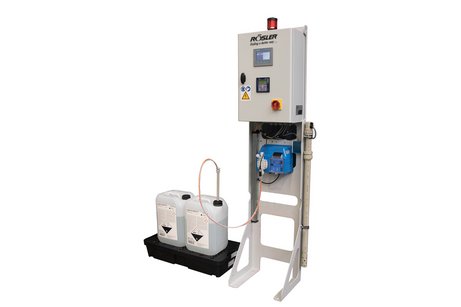
In der im August 2017 in Kraft getretenen 42. Bundesimmissionsschutzverordnung (42. BImSchV) werden vom Gesetzgeber Maßnahmen vorgeschrieben, um die Bildung von gesundheitsgefährdenden Legionellen-Stämmen zu verhindern. Dies betrifft auch das Betreiben von Nassfilter. Die Verordnung verpflichtet u. a. alle Betreiber von Nassabscheidern, regelmäßig aufwendige Prüfungen und Laboruntersuchungen auf Legionellen-Befall durchzuführen und zu dokumentieren. Bei Unterlassung drohen erhebliche Strafen. Unsere Lösung: Auf Grund unserer langjährigen Erfahrung im Umgang mit Prozesswasser, haben wir für alle Nassabscheider ein System entwickelt, dass die Entstehung von Legionellen gänzlich verhindert. Durch Einsatz unserer neuen Dosiereinheit RDS-pH 10/25 in Kombination mit unserem Verfahrensmittel Additiv RST-P1 wird der pH-Wert des Nutzwassers dauerhaft über 10 gehalten. Dies wird automatisch dokumentiert. Das Entstehen von Legionellen wird dadurch im Vorfeld verhindert, Laboruntersuchungen können entfallen und gesetzliche Vorgaben werden zu 100 % erfüllt. Ihr Nutzen: Das Entstehen von gesundheitsgefährdenden Legionellen-Stämmen wird auf einfache Weise verhindert Kosten und Aufwand für Laboruntersuchungen entfallen Vermeidung von hohen Ausfallkosten durch eine notwendige Anlagenreinigung nach einem möglichen Legionellen-Befall Automatische Protokollierung des pH-Wertes im Nutzwasser in ein Betriebstagebuch Geringer Überwachungs- und Wartungsaufwand Kein Aufwand bei Stilllegung zur Urlaubszeit sowie bei der Wiederinbetriebnahme danach Wir beraten Sie gerne weiter. Sie erreichen uns unter der +49 9533 924-333 oder per E-Mail: service-de@rosler.com .

Rösler cleaning centrifuge in the glass industry reduces costs by 90%

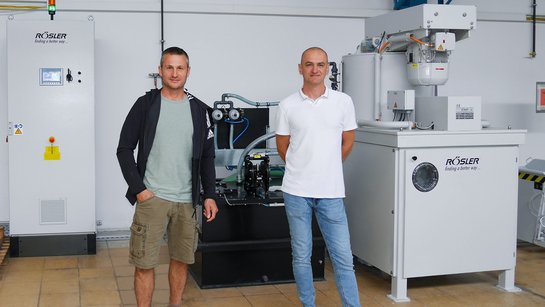
Easy operation thanks to fully automatic processing The automatic RZ 150 A is designed to handle a throughput of 150 liters per minute. In conventional systems the peeling knife, driven by a gear motor, is constantly rotating with the drum. In contrast to this the peeling knife of the Rösler RZ 150 A, located in the center of the sludge drum, is stationary. Only when the sludge deposits in the drum must be discharged, is the peeling knife moving towards the drum wall with a pneumatically actuated linear guide system. This allows peeling the sludge from the drum wall without placing any additional load on the drum bearings. After completion of the peeling cycle the drum is automatically rinsed to remove any residual sludge deposits. This prevents imbalances during the subsequent cleaning cycle, which could lead to premature wear of the drum bearing. The fully automatic process helps saving costs and reduces the consumption of valuable resources. Mr. Stepa, general manager of HART-SM, explains: „The new cleaning centrifuges helped us to reduce our energy consumption and achieve substantial cost savings. For example, we could reduce our idle machine times by 90 percent. And since only the water losses due to evaporation must be replenished, we could significantly reduce the costs for water exchanges. Last-but-not-least, we could reduce the monthly consumption of coolant from about 1,500 liters down to 150 liters, a reduction by nearly 90 percent. In addition to the considerable financial and technical benefits we also achieved a significant improvement of the water quality, an important factor for us as a progressive, future-oriented company. The water system is clean, because it is no longer overloaded with calcium. As a matter of fact, it is totally free of solid particles, which has an extremely positive effect on the overall quality of our products.” Mr. Stepa continues: “The cleaning centrifuge from Rösler represents an innovative solution that brings about a significant added value to our operation. And, of course, it is perfectly in line with our vision for a clean environment. We are pleased to have a company like Rösler as our reliable partner!” Rösler cleaning centrifuges – efficient and effective cleaning of industrial liquids Whether a company has to deal with coolants, sludge from paint processes, the water from industrial work piece cleaning operations or other process liquids, the treatment of the contaminated liquids always depends on the quality of the applied cleaning technology. No doubt the innovative, well-designed centrifugal filtering technology from Rösler offers excellent solutions. To achieve optimum cleaning results for the various industrial liquids, the centrifugal systems are specially adapted to the individual customer requirements. The Rösler centrifuges offer not only numerous technical and financial benefits, but through significant savings of water and other production materials they also help protect the environment. With decades of experience in the field of centrifuges Rösler is a competent, qualified partner for the efficient, energy-saving cleaning of all kinds of industrial liquids.

Mass Finishing Success Requires Constant Operational Focus

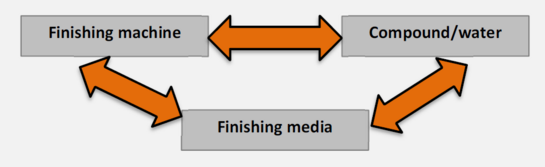
When most companies take on capital expenditure projects such as purchasing mass finishing equipment, very careful attention is paid to investing in the most productive, cost‐efficient equipment as possible to achieve the best possible quality. Operational efficiency is often another story. Once the equipment is up and running routine takes over and less attention is paid to keeping the equipment operating at its peak performance. Whether the machinery is never calibrated to reach its fullest potential or the on-going process is not carefully monitored once the process is dialed in, lacking operational focus can be costly and counterproductive. Figuratively speaking, poorly managed mass finishing operations are pouring money down the drain! Rosler works with its clients to ensure that our machinery delivers initial success and continues to provide precise, repeatable results long into the future by promoting operational attention and heading off costly mistakes. Consequences of Inattention For mass finishing processes, the lack of operational focus may take many forms individually or simultaneously, including: Reduced capacity because of processing times becoming unnecessarily longer. Overall poorer finishing qualities. Unstable processes with erratic finishing. Work pieces requiring additional reprocessing and higher rejection rates. Equipment not providing expected results and return on investment. Such operational deficiencies can cost a lot of money in the short-term when it comes to meeting client expectations and standards as well as the long-term life expectancy and usefulness of the process and machinery utilized. Identifying Issues and Opportunities Careful monitoring of the key process parameters, quick correction of any process abnormalities or “trouble shooting,” and regular preventive maintenance will ensure that a finishing process runs as intended in a cost‐efficient manner. Of course, this should not prevent a company from looking for further improvement and optimizing its current finishing operation. Technical upgrades or new, improved media and/or compounds may have become available for existing equipment which could help increase productivity, reduce costs, and improve the finishing quality. When working with a trusted partner and mass finishing expert such as Rosler, upgrades and advances can often be implemented without completely overhauling a process or purchasing entirely new systems. Optimizing Mass Finishing Operations Achieving the best results from a mass finishing process requires understanding the interaction between the various process components, including: The finishing machine itself. Compounds (liquids, recycling, powder, grinding, polishing, dry polishing, and cleaning/degreasing) and process water. Media – whether ceramic , plastic , or polishing and drying . The success of mass finishing depends on the successful pairing of machines, media, and compounds/water. The desired finishing results – deburring, edge radiusing, cleaning (de‐oiling, descaling) , and surface smoothing and/or polishing – can only be achieved if these process components are carefully calibrated with each other. More than a dozen factors are in play in a mass finishing process and enough complexity to warrant involving experts with experience. Process water from the finishing machine must also be addressed and monitored for optimum results. Depending upon the work piece’s material and original condition as well as the processes performed and consumables used, process water may be contaminated with media and metal fines, chemicals from the compounds, and even chelated metals. Before the process water can be discharged to drain or re‐used in the finishing process, it must be cleaned with a centrifuge . The Rosler Way With more than 80 years of experience, the Rosler team and worldwide Rosler Group have the knowledge and expertise to help you optimize your mass finishing process throughout the machine’s life cycle. Whether you have our equipment or a competitor’s, contact us for advice, sales, and service.