Efficient cleaning of ammunition components in mass finishing systems
, Rüdiger Böhm, Patrick Doliwa - Terug naar overzicht
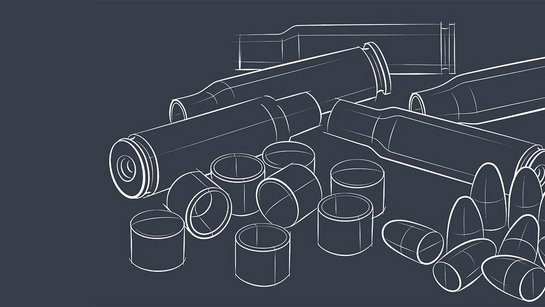
The production of ammunition for sporting, hunting and military applications is extremely energy- and resource-intensive. From circular blanks to cups and deep drawn casings and ultimately to the finished cartridge consisting of the bullet, propellant charge, primer cup and ignition components, the work pieces, primarily made of bras, undergo numerous annealing, deep drawing, forming and machining operations.
What all these manufacturing steps have in common is the use of process aids such as coolants, lubricants and oils. In addition, oxide residues are generated and must be removed from the work piece surfaces after each processing step. Only this ensures reliable downstream processing. Properly prepared surfaces after each drawing stage help prevent defects and cracks during subsequent forming operations. Drying technology also plays a crucial role, ensuring a stable, stain-free and metallically clean surface condition.
From early ammunition processing to sustainable and economical manufacturing
Until the early 1980s, ammunition components were typically cleaned in specialized drum systems that consumed enormous amounts of water, chemicals and energy. The resulting wastewater was often subjected to only minimal treatment before being discharged into the sewer system, causing significant environmental damage.
This approach was not only labor-intensive and, in some cases, environmentally harmful, but also highly energy-intensive and expensive due to the excessive consumption of water and chemical cleaning products.
As wastewater regulations became more stringent, however, a fundamental shift occurred that revolutionized ammunition cleaning processes. Rösler played a key role in the development of environmentally friendly cleaning technologies for ammunition components. Today, compliance with environmental regulations is a central aspect of process design worldwide. The gradual development of modern cleaning processes utilizing mass finishing equipment, precisely controlled dosing of water and chemical additives, and integrated process chains has led to the establishment of comprehensive solution concepts.
Ideally, suppliers of modern ammunition cleaning systems provide complete solutions encompassing machine technology, the production and dosing of compounds and cleaning additives, as well as wastewater treatment systems.
Part-on-part processing in rotary vibrators and WTA systems
The production of cartridges and bullets remains consistently strong. Even during relatively peaceful periods, demand for ammunition for police, sporting and hunting purposes remains high.
As a result, manufacturers require high processing speeds and efficient bulk processing capabilities. One of the first topics discussed with customers is therefore the batch size that can be processed in a single system. Batch weights of up to 500 kilograms are not uncommon in the industry. Such requirements place considerable demands on the equipment, which are further increased by the use of chemical additives and the need for acid-resistant system components.
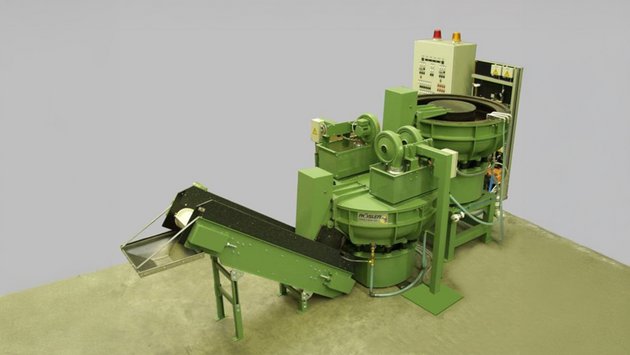
The first processes for finishing ammunition components were carried out in rotary vibrators connected to separate drying systems positioned slightly below the finishing machine. After the wet processing stage, the parts were transferred directly into the drying unit. Since drying takes place in a separate machine, the finishing system becomes immediately available for the next batch. This significantly increases productivity because cleaning and drying can take place almost simultaneously.
Over the years, these systems have been continuously refined through modifications to machine technology. Rotary vibrators with separate drying units are still widely used in the industry today, and demand for such systems remains strong.
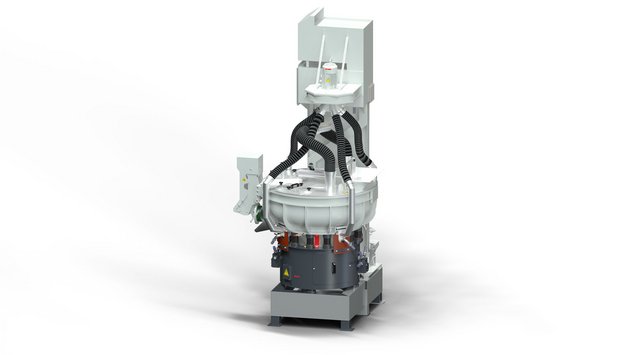
However, many customers now prefer compact washing and drying systems (WTA systems), which combine cleaning and drying within a single machine. To ensure acid resistance during the pickling of cartridge cases and to protect the processing bowl from wear, these systems are lined with polyurethane.

Today, many ammunition manufacturers operate extensive, interconnected production lines in which mass finishing systems are directly integrated into upstream manufacturing processes. Loading, cleaning and drying of ammunition components are carried out fully automatically and with maximum process reliability. The processes employed in these systems have been developed through numerous projects with leading international customers and are now regarded as industry benchmarks.
Compounds, cleaning additives and wastewater treatment:
targeted use for minimal environmental impact
As previously mentioned, the primary objective in processing ammunition components is not material removal (as in grinding or deburring) but rather cleaning, smoothing and polishing. These operations prepare the components for subsequent manufacturing stages.
Processing is typically performed without grinding media or other finishing media, utilizing part-on-part processing instead. Water, cleaning additives and compounds are used to support the process. Effective cleaning of both the external and internal surfaces of cartridge cases and their various drawing stages often requires pickling processes. Even these processes are characterized by comparatively low water and compound consumption.
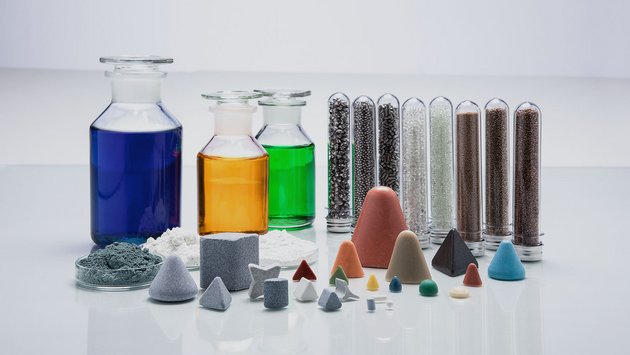
In general, all compounds and cleaning additives must be precisely matched to the specific contaminants and materials being processed. When cleaning brass casings – one of the key work pieces in ammunition manufacturing – special attention must be paid to ensuring that the surface hardness does not increase beyond acceptable limits. Excessive hardening would make subsequent drawing and forming operations impossible.
At the same time, the user-friendly and environmentally compatible compounds developed and manufactured by Rösler should be dosed as economically as possible. Any process chemicals used to remove oily residues or heat-treatment scale must subsequently be removed from the wastewater. The same applies to metal ions released during processing.
Dissolved metal ions such as copper and zinc are removed through wastewater treatment processes involving precipitation and flocculation to ensure compliance with legal discharge limits.
Part-on-part processing reaches its limits only when processing very large components. Large projectile casings with dimensions of up to 500 mm in length and diameters of 300–400 mm require suitable processing media and specially designed equipment.
Processing stages and cycle times
Before completion, cartridge cases typically pass through as many as five drawing stages in which the case head and case mouth are formed. After each drawing stage or machining operation, a mass finishing process is performed.
The specific process depends largely on the type and extent of surface contamination present on the components. Processing times also vary depending on work piece size and geometry. As a general guideline, cleaning and drying operations in ammunition manufacturing typically require between 15 and 30 minutes.
Additional applications for mass finishing:
bullets, anvils and firing pins

Although cartridge cases and their multiple drawing stages account for the largest processing volume in ammunition production, many other cartridge components are also processed in Rösler systems.
Bullets made from lead-copper alloys, for example, require slight smoothing and cleaning after manufacturing to ensure that they can be pressed into the case mouth without resistance. In most cases, dry processing methods are preferred in order to prevent lead residues from entering wastewater.
Ignition components such as firing pins and anvils are also deburred, edge-radiused and cleaned in mass finishing systems after production. Because these are typically very small components, processing is frequently carried out in high energy disc systems equipped with attached drying technology.
Specialized applications and future developments
There are virtually no surface finishing challenges in ammunition manufacturing that cannot be addressed with mass finishing technology. Even fully assembled, ready-to-fire projectiles are processed in Rösler systems. Due to the associated explosion hazards, these applications naturally require special safety measures and continuous process monitoring. In such cases, the objective is purely cosmetic – the creation of a final bright finish.
The limits of what is feasible are currently being redefined, even when it comes to the length of the cartridges to be processed. Together with a leading customer, Rösler is currently developing a process for cleaning particularly long and slender cartridges.
The primary challenge lies in part handling. The process under development must enable rapid loading and unloading while simultaneously preventing the cartridges from bending during handling operations.
Surface finishing in the defense industry offers numerous applications for both mass finishing and shot blasting technologies. In the next article in our blog series, we will explore the possibilities of surface finishing for firearms and handguns. If you have any questions, please contact our defense experts at Rösler.