Solution Finder
SOLUTION FINDER

Su guía a través del
mundo de productos Rösler

Con unos pocos clics encontrará la máquina adecuada a sus necesidades.

Resultados: 237 Artículo - 51 Productos
continuous flow wire mesh belt blast machine

New continuous flow wire mesh belt blast machine from Rösler runs more efficiently and saves valuable resources

Over the course of a project to improve overall productivity and to make the coating of WPC (wood plastic composite) profiles more eco-friendly, the Jürgen Schröder GmbH has invested in new machinery. Specifically, the company purchased a new wire mesh belt machine RDGE 600-L from Rösler. The Jürgen Schröder GmbH, founded in 1980, has established itself in the market as a painting job shop for wooden windows, sun rooms, planed components, all kinds of moldings, doors, etc. For painting wooden components the company, with many years of experience, is also utilizing ultra-modern coating technologies. Decisive factors for choosing the continuous flow wire mesh belt blast machine RDGE 600-L were the excellent quality, the machine design tailored to the company’s requirements and the professional support by the Rösler sales team. Strict requirements regarding performance and sustainability At the moment the WPC profiles, such as base boards or floor boards for decks, are extruded at the suppliers with the color requested by the customers already mixed into the molding compound. This causes frequent production stoppages and material losses at the extrusion lines, whenever a color change takes place. Therefore, it is not surprising that all involved parties wanted to eliminate these color changes by applying the desired color after the extrusion operation. A tailormade equipment concept thanks to the Rösler experts Pre-condition for the optimal adhesion of the applied paint is the best possible surface preparation of the material substrate. The experts from Rösler and the Jürgen Schröder GmbH worked closely together to develop a process that not only met but exceeded the customer’s expectations. Tests to find out how the coatings perform under the most severe weather conditions and mechanical load tests proved very quickly the positive results so that the project could be implemented on an industrial scale. Subsequently, Rösler developed a shot blast solution that is perfectly adapted to the specific work piece requirements and the capacity demands. The new system is also in full compliance with the existing and new logistical manufacturing conditions. By purchasing the continuous flow wire mesh belt blast machine RDGE 600-L the customer could also take advantage of this machine’s small footprint, its high cost efficiency, its ease of maintenance and excellent uptime. The RDGE is equipped with two extremely wear resistant and easy-to-maintain high performance turbines . These are throwing the blast media on the WPC work pieces passing through the machine at a closely controlled speed and impact energy. The effect is a perfectly structured, isotropic work piece surface. An integrated blow-off system is removing all residual blast media and other particles from the shot blasted work pieces. The particular work piece material required the installation of a dry dust collector with built-in explosion protection. Of course, the dust collector is in full compliance with all industrial safety regulations. The shot blast machine, tailored to the specific customer’s needs, met not only his requirements regarding performance, cost and energy efficiency and equipment uptime, but it also represents a significant contribution towards environmental compatibility. Björn Schröder, general manager of the company, summarizes his expectations for the new shot blast machine: „Sustainability and a policy that protects valuable resources have always had a special place in our corporate philosophy”. Against this backdrop it was only natural that the project was partially funded with a grant from the European fund for regional development. „We were impressed by the excellent equipment engineering and the professional advice of the Rösler people at our location and at Rösler’s test center. The integration of the shot blast machine into our existing manufacturing line could also be implemented without any flaws. We will contact Rösler for any future shot blast projects”, summarizes Björn Schröder, general manager of the Jürgen Schröder GmbH.

Polishing Processes Benefit from Pre-tumbled Media

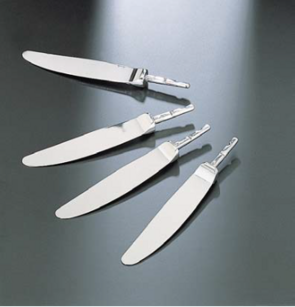
Media selection is key in any surface finishing process since these consumables are essential “precision tools” required to achieve the specified finishing results. Whether you are developing a new mass finishing process or changing process parameters including different work pieces, process times, and requirements, partnering with an experienced expert will help you in evaluating all process parameters. With decades of experience developing mass finishing machines and manufacturing media and compounds , Rosler is an excellent source for guidance. In some cases, pre-tumbled media may be suggested. What is Pre-tumbled Media? After production, some types of pre-polishing and polishing media are pre-tumbled by the manufacturer. This process breaks sharp points and corners off individual media pieces to create smoother edges. Without this step, media still has sharp edges and a relatively rough surface. For heavy‐duty deburring and surface grinding this abrasiveness produces a welcome benefit. Yet for pre‐polishing and polishing purposes it is a distinct disadvantage since the initial surface conditions of the media can cause micro scratches and prevent the desired smooth/polished finish. Polished knives processed with pre-tumbled media When is Pre-tumbled Media Useful? The need for pre-tumbled media applies primarily to finishing tasks requiring a very smooth surface finish with the ultimate goal of a high-gloss polish. These polishes can only be achieved with pre-tumbled media. In addition to the desired process, the state of the process may also factor into the need for pre-tumbled media. For new processes requiring a complete load of new media, the use of pre-tumbled media is an absolute must while media for established processes may not need pre-tumbling if only small quantities of new media are added to offset media wear and undersized media discharge. When in Doubt, Test Your Media. Whether your process uses ceramic, plastic, or drying and polishing media, a crucial step in selecting media should always be consulting experts, i.e. your supplier. Since a media change might require extended test trials, an experienced partner should test prospective media with your specific work piece in their test lab. Rosler test center The Rosler Way With more than 80 years of experience in surface finishing, the Rosler team is well equipped to provide media selection guidance and FREE testing in our global test centers . For new processes and adjustments, contact us for all your surface finishing and media needs!
rotary vibrator

Double-batch mass finishing system for wet and dry finishing process

Highly flexible and efficient solution for processing of zinc die-castings Gjuteriteknik, a Swedish foundry specialized in zinc die-casting, was looking for a mass finishing system that allows the fully automatic and cost-efficient running of different finishing processes. With the mass finishing system R 420 2-CH Rösler was able to provide the ideal solution. This system allows the simultaneous dry or wet processing of two work piece batches, including the drying of the finished work pieces, with a high degree of process stability. In the mid 1990’s the foundry Gjuteriteknik AB, founded in 1978, made the strategic decision to exclusively specialize in the production of zinc die-castings. This family-owned company, located in Värnamo, Sweden, and run by the second generation owners Jonas und Peter Abrahamsson, has successfully established itself in this field and produces about one million castings per day. The company’s services include the design phase for a product, the production, surface refinement and logistics. With this comprehensive portfolio the zinc die-casting specialist Gjuteriteknik is partner of a wide range of companies active in the fields of telecommunication, electronics, automotive, furniture and construction in Europe, Asia and South-America. A recipe for success - flexibility, quality and automation Jonas Abrahamsson comments: „Zinc die-casting is a relatively small segment in the foundry industry. To be competitive on an international level, as a Swedish company we must not only be highly flexible in the fulfillment of the customer requirements but must also be very cost-competitive. We have achieved this by the implementation of highly automated processes throughout our entire manufacturing operation”. Mr. Abrahamsson continues: „Our goal is to produce casting qualities that require no additional processing. However, if the work pieces had to be deburred, we did this predominantly in fully automatic shot blasting cells. One reason for this approach was that our old mass finishing system offered only very limited processing possibilities and required a lot of manual operations”. Therefore, when the company decided to purchase a new mass finishing system, its main requirements were flexible processing possibilities, an automated process from the loading of the work pieces to their discharge after the drying operation and a high capacity. Because of its excellent experience with the existing Rösler mass finishing and shot blast equipment, Gjuteriteknik decided to purchase a system that consists of a double-batch rotary vibrator, model R 420 2-CH , a hot air belt dryer and a centrifuge for cleaning and recycling of the process water. Another reason for purchasing the Rösler system was that it fully met the cycle time requirements of the customer. Efficient, parallel wet or dry processing At the center of the double batch system, allowing the parallel processing of two work piece batches, is a rotary vibrator with a gross volume of 420 liters that is suitable for wet as well as dry finishing operations. „We already had one project for dry finishing of the work pieces. And we knew that the demand for dry finishing would grow significantly. Therefore, it was very important for us to process the work pieces fully automatically, which so far had not been possible. For this reason, process flexibility had top-priority”, explains the managing director. For the mass finishing operation customer-supplied bins with raw work pieces are placed into the lift and tip loading device that transfers the work pieces into a vibratory hopper. After the operator has entered the work piece identification into the PLC, the work piece specific processing program starts automatically. While the vibratory hopper transports the raw zinc die-castings into the rotary vibrator, the loading device moves back into its home position. This allows placing another batch of work pieces into the loader and selecting the respective program. After the pre-programmed processing time an unload gate in the bottom of the rotary vibrator is opened, and the mix of media and finished work pieces is discharged onto a vibratory buffer with an infinitely adjustable vibration intensity. As soon as the processing bowl is empty, the unload gate is closed, and the processing bowl is filled with another batch of media and raw work pieces. At the same time the vibratory buffer gently transfers the mix of finished work pieces and media into the vibratory screen separation unit, where media and work pieces are separated. An undersize media screen ensures that during the separation operation media that has become too small, is discharged from the system. This ensures a high process stability. Within certain time intervals new media is manually added to the system. The area around the vibratory separation unit was designed as a separate safety zone, which can be safely entered, while the rotary vibrator is running. This allows placing empty part bins for work pieces that were finished in a dry process and discharged through a movable vibratory cross conveyor. Work pieces that underwent a wet finishing process are transferred to the two meter long hot air belt dryer R 2000 BT. Cleaning and recycling of the process water by centrifuge During wet finishing processes a high water-compound flow through the rotary vibrator ensures a complete and safe flushing out of contaminants such as metal and media fines, etc. The water/compound mix flows into the rotary vibrator from the top, is discharged through bottom drains and then pumped to the semi-automatic centrifuge Z 800. To promote the separation of the solids from the process water in the centrifuge, flocculants are automatically dosed into the process water. The cleaned water is pumped to a clear water tank. As needed, compound is injected into the process water fully automatically. This guarantees a constant compound concentration and, therefore, absolutely repeatable, high-quality finishing results. Jonas Abrahamsson concludes: „The new mass finishing system permits us to adapt our finishing processes to the work pieces and, thus, enables us to perfectly fulfill the requirements of our customers. We are very happy with the new equipment and feel that we are well prepared for any future finishing challenges”.
wet blasting technology, part 4 - typical wet blasting applications

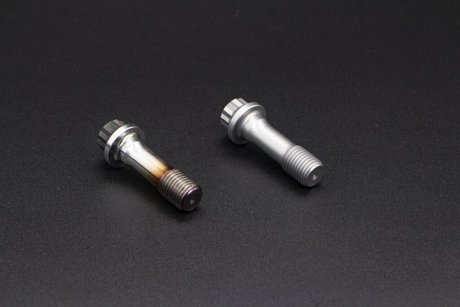
Wet blasting can do nearly any job that is done with dry shot blasting . The defining differences are that wet blasting does so more gently and without producing dust. In addition, wet blasting can handle a small amount of oil and grease unlike dry blasting. At Rosler , we have more than 80 years’ experience in surface finishing . While wet blasting has gained popularity recently, we’ve used this technique to provide precise, repeatable results to a number of industries over the years. Typical Applications With proper testing and process parameters, wet blasting can achieve numerous surface finishing goals. Cleaning A fastener with heat discoloration before versus after wet blasting. Depending on the work piece’s starting condition and successive finishing steps, rust, scale, oxidation, road grime, grease, and oil may need to be removed. Wet blasting can accomplish a variety of cleaning applications including: Dies and molds such as die castings and tire and glass molds. Automotive rebuilds such as engines, transmissions, brakes, etc. Investment castings such as boat propellers, pump impellers, housings, valve bodies, etc. Aircraft engine rebuilds. Various components before inspection or secondary processing. Burr Removal Hydraulic components before and after wet blasting. Work pieces with flashings and burrs must undergo deburring and deflashing. For example, firearm components require burr removal after drilling, milling, and turning. Drill bits and milling tools also require burr removal. Descaling Despite the newest heat treatment processes, discoloration, oxidation, scale, and hard residues are found on cast and forged products as a result of manufacturing and environmental influences. Modern production methods, control and testing processes, and an uninterrupted continual processing of the cast and forged parts requires clean, light work piece surfaces. Surface Texturing Creating a somewhat rougher surface finish is a key step in preparation for painting, coating, and bonding with glue. Ensuring that subsequently applied coatings have a rough enough surface to adhere to improves the quality and life span of a work piece. Examples of wet blasting applications for surface texturing include: Preparation of automotive parts for rubber coating such as brake and engine seals. Surface preparation to place a corrosion protection coating for screws. Surface preparation to place a primer on airplane components such as rotor blades, stringers, and wing spars. Orthopedic implants in which osseointegration and bone growth around the implant are encouraged. Light profiling of tibia plates, knee femorals, hip stems, and spinal implants helps promote this bone growth. Stripping of Paint and Coatings Wet blasting is ideal for stripping of paint and coatings from delicate work pieces. Processing of mineral-based construction materials such as concrete or sandstone, glass, textiles, and wood is possible with Rosler machines as well as the finishing of plastics and metals. Cosmetic Finishing Wet blasting removes machining lines from aluminum gun bodies as shown in these before and after examples. Wet blasting serves as an excellent method of applying a uniform, matte finish on work pieces. This finish can take various forms, including: Creating a pre-polish finish smoother than what can be achieved with dry blasting. Applying a non-glare, matte finish such as the finish required for surgical instruments. Masking machining lines on a variety of parts like tibia implants or aluminum gun bodies. Shot Peening Landing gear includes many wet blasted components. Shot peening is a process specially developed to improve the properties of components which are exposed to changing strains. For safety reasons, shot peening is also now absolutely necessary in the aviation and space industries . Shot peening is also essential in all industries requiring long lives for components including the automotive sector. Wet blasting applications for shot peening are mainly used in conjunction with Almen strip N for glass beads, ceramic beads , and stainless steel shot . Additive Manufacturing Post Processing Additively manufactured components before and after wet blasting. Wet blasting is an essential technology for various post processing tasks, specifically additive manufacturing. Wet blasting cleans the 3D printed components by removing residual powder and significantly reduces their initial high surface roughness. It is capable of de-powdering and providing general surface cleaning and initial surface smoothing from Ra = 1,000 micro inches down to Ra = 40-60 micro inches (25 µm to 1–1.5 µm). On metal AM parts the loosely sintered grains on corners are effectively removed. The wet process eliminates the worry about residual powder containment or sparking during the blasting process. De-contamination of nuclear power plant components Manual wet blast cabinets allows for same removal of contaminants. Removal of small, radioactive fragments from the component surface in nuclear power plants can also be achieved through wet blasting. The process decontaminates the components to a point where they can be declassified as radioactive. Special consideration regarding the water treatment are required to meet the requirements for this application. The Rosler Way With a trusted partner such as Rosler, you don’t need to worry about the ins and outs of an application. Contact us to discuss your wet blasting needs and challenges and we will deliver a solution. We’ll even demonstrate results with FREE sample processing in one of our global test centers . That’s the Rosler Way. The complete Wet Blasting Technology Series includes: Part 1 – “Wet Blasting Gently Delivers Dramatic Finishing Results.” Part 2 – “Comparing Attributes, Advantages to Dry Blasting.” Part 3 – “Technical Features, Slurry Control Achieve Precise Finishing.” Part 4 – “Typical Wet Blasting Applications.” Part 5 – “PureFinish® Offers Food-Grade Excellence.” Sign up for enews alerts to be notified of all Rosler blog posts!
automatic replenishment system

Rösler introduces fully automatic antistatic compound replenishment system - another milestone for process safety and quality

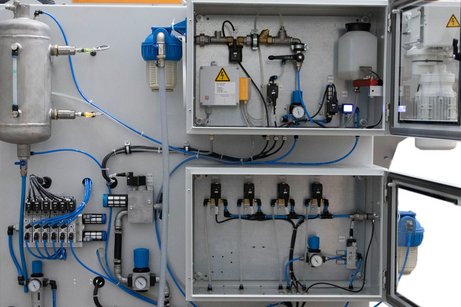
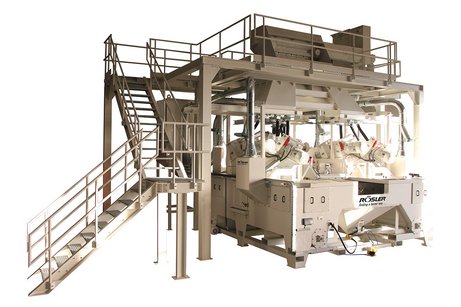
Electrostatic charges are frequently a reason for difficulties in our everyday life. The use of plastic blast media, such as polyamide, inevitably causes electrostatic charging of the media pellets, work pieces or dust particles with the result that these items are sticking to each other. This can impede the handling and functionality of the work pieces. Especially the carryover of dust and blast media can cause serious problems with downstream manufacturing operations ranging from equipment failures to the malfunction of electrical components. For many years this problem has been overcome by the addition of liquid antistatic compounds, which are dosed into the blast chamber with special nozzles from a storage tank. The dosing quantity is predominantly controlled by timing relays, timing switches or timing functions in the PLC. Fully automatic dosing of the antistatic compound offers significant benefits To date the machine operator had to manually replenish the antistatic compound in the storage tank. This requires the mixing of a relatively small quantity of antistatic concentrate with a relatively large quantity of water. A major problem with the manual mixing procedure is that a permanent achieving the optimum mixing ratio is rather difficult. A poor mixing ratio will not lead to a sufficient remove of dust and residual blast media from the work pieces and can, therefore, seriously threaten the overall process safety. With the development of the “automatic antistatic dosing equipment” the Rösler experts found a way to overcome this problem. For the automatic replenishment process the machine operator simply enters the exact mixing ratio between concentrate and water on the PLC touch panel. As soon as the minimum fill level in the storage tank has been reached, water is automatically added through the connected water pipe. At the same time a dosing pump is adding a precise quantity of antistatic concentrate from a special canister. This ensures that the pre-defined mixing ratio between water and antistatic compound is maintained during the entire shot blast process. The result is a drastic improvement of the process safety and quality. Faulty dosing of the antistatic concentrate and handling of the empty storage tank are, therefore, completely eliminated.
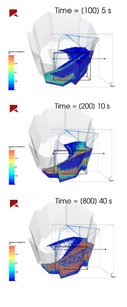
Example of a simulation that displays the blast results in a work piece batch after different time intervals.

Exploring the shot blasting process - Simulation helps create perfect surface finishes for raw castings

In the foundry industry many production processes are developed by the use of simulations. But the actual casting phase is followed by further manufacturing stages adding value to the raw work pieces. One such operation is the surface refinement by shot blasting and mass finishing as offered by the Rösler company. Both technologies are cleaning the castings and generate precisely defined surface characteristics. The development of shot blasting systems and the underlying shot blasting processes is mostly based on decades of experience and knowhow. In its efforts to further refine these processes and improve their efficiency, the Rösler Oberflächentechnik is utilizing various simulation software modules and adapting them to specific surface refinement targets. With the modified software the achievable work piece surface finishes can now be demonstrated. Furthermore, it allows simulating various treatment modes such as single piece or batch processing, where the work pieces are tumbling over each other. The knowledge gained by such simulations provides valuable information about the optimal arrangement of the blast media acceleration systems like turbines or blast nozzles in relation to the work pieces to be blasted. With the software such processes as blast cleaning, cosmetic blasting, blast chipping and shot peening can be demonstrated. It also allows the simulation of different work piece transport systems to analyze the mixing and shot blast effect in work piece batches, where the work pieces are tumbling over each other. The simulations have shown that the blast performance of actual shot blast processes can be improved by 20 to 30%. Such improvements are directly reflected in shorter cycle times and reduced energy consumption.

Centrifuge Technology, Part 2 – Operational and Economic Benefits of Recycling Process Water

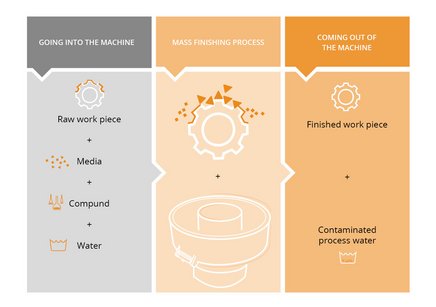
During mass finishing , the process water injected into the finishing machine is contaminated with the chemical ingredients of the compounds , fines from the grinding or polishing media, and metal fines from the work pieces. In case of ball burnishing, when acidic or alkaline compounds are used, the process water can also contain dissolved metals or be alkaline or acidic. Or, for example, when the work pieces are covered with oil from machining or stamping operations, the water can even be contaminated with oil. Rosler has developed a series of closed-loop, water circulation systems using centrifuge technology to remove these contaminants regardless of their origin and allow clean process water to be reused and/or safely discharged. In addition to offering more effective work piece processing, cleaning process water saves money and the environment through reduced consumption, compound usage, disposal costs, and regulations. Mass finishing input and output Environmental Stewardship Depending on the machine size, type, and its application, a single mass finishing machine can use between 10 and up to 250 gallons of water per hour amounting to as much as 2,000 gallons during every 8-hour shift. Considering that the average household uses approximately 140 gallons per day, this is a lot of water that is literally going down the drain. The centrifugal cleaning process separates solids in the form of media and metal fines from the process water without removing the compound. This allows the cleaned process water to be reused in the mass finishing machine. A small amount of compound is consumed to keep the process stable and some water losses occur due to carry-out by the work pieces and evaporation. On average, centrifugal cleaning and recycling of the process water results in water and compound savings of 90 to 95%. Reduced Municipal Regulations Centrifuge technology does not require approval from municipal water authorities since the cleaned process water is reused rather than being discharged into a sewer. Recycling process water saves time by not having to undergo the elaborate discharge approval process. It also eliminates the need for regular water analysis to ensure that the cleaned water going to sewage is indeed in compliance with the legal limits for hazardous materials. https://videopress.com/v/gU0wE8kR?preloadContent=metadata Easy Operation Contrary to conventional waste water cleaning methods, centrifuges are easy to operate and require very little operator involvement. Above all, they require no special training or specialized knowledge. The water level in automatic centrifugal cleaning and recycling systems is automatically monitored, and any water/compound losses due to carry-out and evaporation are made up by fully automatic water/compound dosing units. For applications in conjunction with high-energy mass finishing machines that generate a lot of heat, the centrifuges can be equipped with a special cooling system for controlling the temperature of the process water. In case of semi-automatic centrifuges, an operator must periodically remove the accumulated sludge in the centrifuge drum. This is typically done once every few hours or once per day. In fully automatic centrifuges even the sludge removal is automated. A timer-controlled peeling knife periodically removes the sludge from the drum wall and discharges it into a waiting sludge bin. All the operator must do is empty the sludge bin every few days or, in some cases, weeks. At left, a fully automatic centrifuge during the cleaning cycle is shown. On the right, a sludge discharge peeling cycle is shown. The Rosler Way Centrifugal process water cleaning and recycling makes a significant contribution towards ecologically sustainable production and is a prime example for environmental stewardship in manufacturing. Contact Rosler today to learn how we can improve the efficiency and economic impact of your mass finishing process. Previous posts in the Centrifuge Technology series include: Part 1 – “Water Cleaning Systems Replace Outdated Methods.” Part 2 – “Operational and Economic Benefits of Recycling Process Water.” Part 3 – “Mechanics and Limitations of Water Recycling.” Part 4 – “Pre-Conditions and Consumables Enhance Process Efficiency.” Upcoming posts in the Centrifuge Technology series will include: Part 5 – “Potential Issues and Remedies for Water Recycling.” Sign up for enews alerts to be notified of new posts!
continuous feed looped belt shot blast machine

Top quality – Rösler installs a convincing new plastic de-flashing system at Berker in in Ottfingen

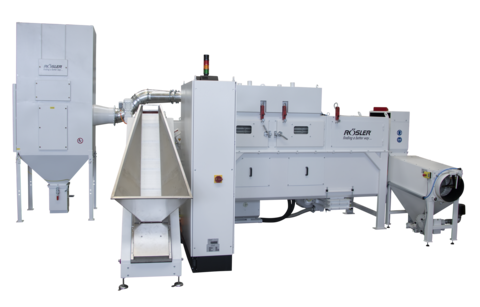
For over 30 years the Berker GmbH & Co KG has been de-flashing plastic components like switching elements, electrical outlet covers, frames, etc., with Rösler shot blast equipment. The company is mainly using continuous feed systems such as loop and flat belt machines. Berker – since 2010 a member of the Hager Group – is one of the leading manufacturers of high-end electrical components – from timeless classical switches to intelligent electrical systems for buildings. The company also supplies switches for electrical appliances and automobiles. Because of an increasing production volume at its Wenden-Ottfingen manufacturing location, in 2018 Berker had to invest in an additional shot blast machine. The new investment was intended to replace an existing continuous feed loop belt system with the latest de-flashing technology. The specifications called for increased capacity and a high equipment availability. After the capacity requirements had been established, Rösler developed a system concept that fully met the customer’s technical and economic demands. Equipped with two direct-drive blast turbines, the new Rösler machine produces excellent de-flashing results combined with an extremely high degree of process stability. This is achieved by a host of technical features like modern PLC controls, an optimized media cleaning and recycling system with vibratory screen and air wash separator, a sensor-controlled media replenishment unit, the automatic replenishment and mixing of anti-static compound, noise protection, an automatic-stand-by module and the Rösler dust collector emitting a minimum of residual dust. An additional bonus was that the new machine design allows the automatic de-flashing of large work pieces, which could not be handled with the old equipment. The above technical highlights convinced the Berker GmbH & Co. KG to purchase the new continuous feed loop belt blast machine RSBS 1702 from Rösler. Unfortunately, the Corona pandemic caused a delivery delay. But the new plastic de-flashing system could finally be commissioned at the customer’s Wenden location in July 2020.

Wet Blasting Technology, Part 3 – Technical Features, Slurry Control Achieve Precise Finishing

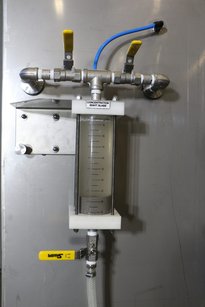
Numerous technical features combine to make wet blasting an effective method of surface finishing . When expertly combined by an experienced finishing expert such as Rosler , this method can achieve precise and repeatable results on a variety of work pieces from a wide range of industries . A general understanding of the essential technical elements of a wet blasting machine will help you select a machine for your specific needs as well as prolonging the efficiency and life of existing wet blasting equipment. Technical Highlights Rosler Wet Blast Schematic The numbered diagram details the wet blast principle and the basic features of a wet blast system. Blast chamber with slurry tank – A mix of media and water is stored in this holding tank found at the bottom of the blast chamber. The chamber is made of stainless steel. Compressed air – Approximately 70 PSI of compressed air accelerates the slurry. Blast gun(s) – One or more guns accelerate the slurry supplied by the slurry pump with compressed air. Blast media feed – Media enters the machine. Slurry pump – This high-powered mechanism transports the slurry to the blast gun(s). Larger wet blast systems can be equipped with multiple pumps. Slurry agitator (stirrer nozzle) – In order to keep the media suspended in the water, the slurry pump diverts some of its flow to a stirrer nozzle placed in the tank to agitate the mix of water and abrasives. Overflow – Small media particles, dirt, and other contaminants tend to stay suspended and are skimmed off and sent to the filtration unit. Water filtration system – Media particles and debris skimmed off the water’s surface must be passed through a filtration system to separate still usable media and process water from waste. Common filtration methods include hydro cyclones, weir tanks, bag filters, paper band filters, and semi- and fully automatic centrifuges. Filtered water – Once processed by a water filtration system, water is returned to the slurry tank and reused. Exhaust vent – The water mist mixed with media fines and other small particulates is removed from blast cabinet by suction fan-equipped filters. Controlling Slurry Concentrations Depending on the specific wet blast process, the typical concentration of abrasive media in the slurry ranges from 10 to 40% by volume. Establishing the ideal concentration usually requires more or less extensive processing trials. During the blast process the media wears by becoming smaller or fracturing and must be removed from the system. To make up for this loss, good media must be added. To consistently achieve the desired high-quality blasting results, the established slurry concentration must be maintained within a very tight tolerance range of 1-2%. This can be done by visual inspection of the viewing glass and manually adding media as needed. However, in larger blast systems the slurry concentration is controlled automatically with an ultrasonic level sensor, a weighing system, or continuous density measurement. Adding media to the desired concentration level can be done manually or through an automated, PLC controlled media adder. Manual slurry concentration measurement unit The Rosler Way Building standard and custom wet blasting equipment to deliver precise, repeatable results is the Rosler Way. Contact us to learn how we can solve your surface finishing challenges and to request a FREE sample processing in one of our global test centers . The complete Wet Blasting Technology Series includes: Part 1 – “Wet Blasting Gently Delivers Dramatic Finishing Results.” Part 2 – “Comparing Attributes, Advantages to Dry Blasting.” Part 3 – “Technical Features, Slurry Control Achieve Precise Finishing.” Part 4 – “Typical Wet Blasting Applications.” Part 5 – “PureFinish® Offers Food-Grade Excellence.” Sign up for enews alerts to be notified of all Rosler blog posts!
crankshaft shot blast machine RKWS 3/4

Rösler presents a convincing equipment maintenance concept to thyssenkrupp Gerlach GmbH

For a company to become and remain a leader in its respective industry demands that it constantly reviews and improves its products and the underlying manufacturing processes. With its competence and knowhow in materials for drive trains, chassis and automobile manufacturing equipment the automotive division of the world renowned thyssenkrupp AG is a significant contributor towards the technical progress and efficiency of motor vehicles. The thyssenkrupp Gerlach GmbH plant in Homburg, Germany, is a leading partner for the development of automobile engine components and offers a full service package ranging from the design of specific components, the fabrication of prototypes to full-scale production. To improve the cost efficiency at its Homburg plant and to meet all the customer requirements, in 2016 the company installed its high-tech “production line 19” for forged crankshafts for engines with 1 to 4 cylinders. For this line the engineers of the surface refinement specialist Rösler developed an innovative shot blast equipment concept that was so convincing that the thyssenkrupp management placed an order for the new Rösler “RKWS” crankshaft shot blasting system. The fastest crankshaft forge shop in the world At the beginning of the manufacturing sequence the bar blanks are cut to length. Before being shaped in a 6,500 ton press, they are heated in an induction oven. In a last step the crankshafts undergo a blast cleaning process in a shot blast machine. For the last operation the Rösler engineers developed a unique equipment concept that allows the handling of different work piece sizes without time-consuming retooling of the work piece holders. This helped reduce the cycle time to less than 10 seconds, which in turn allowed the manufacturing operation to be run in continuous flow. The result of the comprehensive cooperation of thyssenkrupp with Rösler and all the other partners was the fastest, most modern crankshaft forge shop in the world that produces a finished component for its customers every 7.5 seconds. The “RKWS” system – designed for long life and easy maintenance The three blast chambers and the work piece load/unload chamber are arranged in a circle around a rotary drive equipped with an asynchronous servo motor with an extremely high overload reserve. The blast media is accelerated and thrown by Rösler Gamma blast turbines equipped with the worldwide unique “Y” design of the throwing blades. The critical wear components of the Gamma turbines are not made of chilled iron castings, typically used in conventional turbines, but of forged tool steel. This results in a much longer uptime of, for example, the throwing blades. The blade curvature produces a much higher throwing speed than straight throwing blades. In addition, the symmetrical “Y” design allows the use of both blade sides. The combination of more wear resistant material and the blade geometry result in an up to 3 times longer usable blade life. Another feature of the Gamma turbines is their easy maintenance. Turning the blades around or exchanging them can be done from the top of the turbine housing without having to dismount impeller, control cage and the media inlet tube required with conventional turbines. The RKWS is equipped with 12 Gamma turbines, each with an installed power of 22 kW. The turbines, evenly placed on the three blast chambers, are throwing the large steel shot onto the entire surface area of the crankshafts with a speed of 80 meters pe second. This results in a complete removal of forging scale and other surface contaminants. By utilizing highly wear resistant material for all components exposed to the large cast steel shot and the removed forging scale, the Rösler engineers ensured that the RKWS shot blast system was not exposed to excessive wear. The three blast chambers were lined with wear resistant hardened steel. The media augers were made from special steel that is predominantly utilized in the mining industry. Technical characteristics of this material are its extreme toughness and its remarkable hardness of 600 Vickers providing it with a considerable structural strength. Smart maintenance concept The entire volume of customer orders is handled by the new “production line 19” within 21 shifts per week. This poses a considerable organizational challenge for the thyssenkrupp Gerlach GmbH maintenance department. For managing the time for the equipment upkeep the maintenance team, led by Markus Kania, decided to introduce a TBM system (time based maintenance). Within a pre-determined time span a recurring time window is defined for all inspection and maintenance activities as well as any required repairs including the replacement of spare parts. The time management allows requisitioning all repair materials in advance and facilitates the effective assignment of the maintenance personnel at thyssenkrupp Gerlach GmbH in Homburg. Adequate spare parts stock allows sustainable long-term planning Planning certainty for the entire manufacturing line, along with a constant high product quality, is a high priority at thyssenkrupp Gerlach GmbH. For this reason, the project leader, Markus Kania, made sure that besides a forward looking preventive maintenance the essential wear and spare parts for all machines were determined jointly with the equipment suppliers and stocked on site in Homburg. To define the specific requirements for the crankshaft shot blast machine the customer relied on the experience of the Rösler service department. Based on the customer specifications the service experts at Rösler conducted a risk and wear analysis. For this purpose they utilized a ultra-modern simulation of the blast media recycling process that allowed them to determine the wear intensity for every single component. Based on the results of the analysis a comprehensive list of recommended spare parts was prepared including wear parts such as protective wear plates, etc. „The professionalism displayed during the preparation and presentation of the list of recommended spare parts with assembly drawings and 3D models was so impressive that after a brief internal discussion at thyssenkrupp we placed an order for the recommended wear and spare parts”, explains Markus Kania. He continues “With the maintenance and spare parts concept we minimize the risk of downtimes and save time and money during the procurement process. This will be a significant contribution towards strengthening our competitive advantage at our Homburg location”. For special situations the maintenance team of the “PL 19” can rely on the quick response by the Rösler service department. The Rösler manufacturing depth with short production times and express delivery of practically all spare parts is no doubt a great advantage. The excellent cooperation with Rösler during the entire project was the main reason that thyssenkrupp Gerlach GmbH decided to work again with the surface refinement specialist from Memmelsdorf for a new investment project at the Homburg location. This time the customer plans to establish a new production line for the manufacture of axles and crankshafts for heavy-duty transport vehicles.

Centrifuge Technology, Part 1 – Water Cleaning Systems Replace Outdated Methods

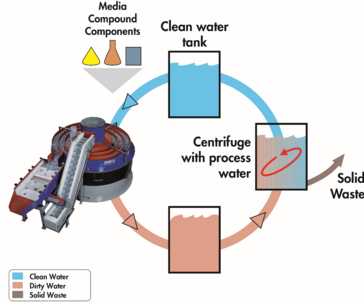
Before the “dirty” process water coming from a mass finishing operation can be discharged to sewage, it must be cleaned to meet the legal discharge limits for hazardous materials. Likewise, for cycling the water back to the mass finishing process, the process water must also be cleaned. Uncleaned process water would cause a mass finishing process to collapse very quickly. Rosler has more than 80 years of surface finishing expertise. In that time, we’ve developed countless efficiencies in both the design of our equipment and the processes they support. Centrifuge technology has long been an effective and cost-efficient tool, not only for cleaning the process water, but also for reusing it for the actual mass finishing operation. Previous Cleaning Methods To a large extent, this technology has replaced traditional waste water cleaning methods. Until recently, the most common cleaning systems for mass finishing applications were settlement tanks and flocculation (“floc & drop”) systems. Settlement Tanks In settlement tanks the “dirty” water is collected in big tanks. The solid particles suspended in the liquid settle to the bottom over time, creating a time-consuming and rather messy cleaning method. Above all, this method does not meet the legal discharge limits for removing contaminants from the solution, including: COD values (chemical oxygen demand). Solid particles. Oil. Metal. As a result, settlement tanks are rapidly being replaced by more environmentally friendly cleaning systems. “Floc & Drop” Systems “Dirty” process water is collected in a large tank in “floc & drop” systems. Flocculants are added to the water to coagulate the tiny solid particles and emulsified oil droplets into larger flocs. These flocs sink to the bottom of the tank and are then pumped to a filter press or bag. Unlike settlement tanks, water discharged from “floc & drop” systems meets legal standards and can be discharged to sewage. These systems are very labor intensive and often rely on operator to ensure all steps are taken to meet the authorized discharge limits. Other Methods & Special Uses Evaporators and membrane filtration systems are occasionally used for mass finishing operations as well. Except for settlement tanks, which are pretty much obsolete, the other waste water systems mentioned still have a place in mass finishing operations particularly for special applications. In general, these systems are costly and somewhat difficult to operate compared to centrifuges. Above all, non-centrifugal methods do not allow the recycling of the cleaned process water for reuse in the respective mass finishing process! Unique Capabilities In recent years, centrifuges (also called centrifugal filters) have proven to be the most effective, cost-efficient, and ecologically sustainable cleaning systems for the “dirty” process water generated in mass finishing operations. Centrifuges are very easy to handle and require no special knowledge to operate them. Furthermore, they require no permits from local water authorities. Centrifuge Recycling Schematic They also excel when it comes to cost savings and consumption. Centrifuge technology can reduce the water and compound consumption in mass finishing operations by up to 95%. This saves not only money but makes a substantial contribution toward environmental sustainability in manufacturing. In short, cleaning centrifuges represent a rare industrial equipment category, where economic benefits go hand-in-hand with ecological objectives and environmental stewardship! The Rosler Way “Finding a better way…” is more than a motto at Rosler; it’s our mission. The use of centrifuge technology in mass finishing operations is just one of our many innovations. Contact us today to learn how we can help solve your unique surface finishing challenges. Previous posts in the Centrifuge Technology series include: Part 1 – “Water Cleaning Systems Replace Outdated Methods.” Part 2 – “Operational and Economic Benefits of Recycling Process Water.” Part 3 – “Mechanics and Limitations of Water Recycling.” Part 4 – “Pre-Conditions and Consumables Enhance Process Efficiency.” Upcoming posts in the Centrifuge Technology series will include: Part 5 – “Potential Issues and Remedies for Water Recycling.” Sign up for enews alerts to be notified of new posts!

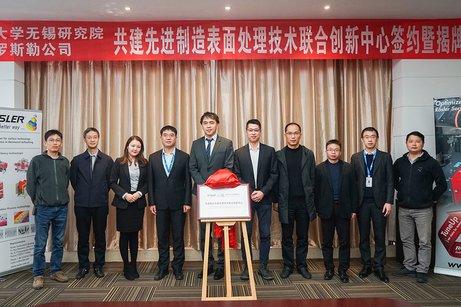
Rösler China and HUST announce their strategic cooperation for the development of forward-looking surface treatment technologies for jet engine components

„Finding a better way” is an essential part of the corporate philosophy of Rösler that is practiced daily. This is highlighted by the recently concluded cooperation agreement of the Chinese Rösler subsidiary, Rosler Surface-Tech (Beijing) Co., Ltd., with the renowned Huazhong University of Science and Technology, WUXI Institute (HUST) in the field of forward-looking surface treatment technologies for jet engine components. As one of the top 10 universities in China, the HUST is known for numerous successful research projects in the Chinese high-tech sector. Its research focus is on the fields of aerospace, medicine and robotics. Since 2019 HUST also works on innovative manufacturing technologies for jet engines and the adaptation of these technologies to series production. The new "Joint Innovation Center for Advanced Manufacturing Surface Treatment Technology" is financed by HUST, AECC and the WUXI government. On the technical side it is supported by Rösler China. Goal of the new innovation center is the development of future-oriented surface refinement methods for BLISKs and compressor, as well as, turbine blades. During a joint visit on the occasion of the opening of the innovation center, Yiling Sun, General Manager of Rösler China, demonstrated a linked system in the form of a rotary vibrator without inner dome (R 420 DL), a transport belt (R 360/3000 FB/T), a vibratory separation unit (R 12/6 SM-E) and a process water cleaning centrifuge (Z 1000 ASS-II-Turbo) to the guests and explained the entire finishing process in detail. On this occasion it was agreed that further investments will be made in the innovation center. Stephan Rösler, President & CEO of the Rösler Oberflächentechnik GmbH, explains: „The strategic partnership with the Huazhong University of Science and Technology allows us to consolidate and expand our outstanding position in an extremely important market segment. It will enable us to offer even more innovative solutions in the field of equipment and process development for the aerospace industry”.

Wet Blasting Technology, Part 2 – Comparing Attributes, Advantages to Dry Blasting

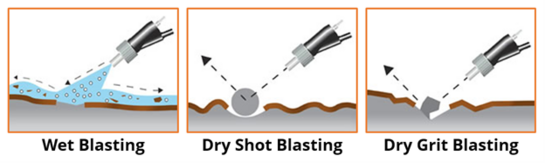
Unlike dry blasting in which only solid abrasive media is used, wet blasting processes use a slurry in which the media is embedded in water. This greatly cushions the impact energy on the work pieces, providing gentler, yet effective results for delicate work pieces. As the utilization of wet blasting increases, Rosler reminds manufacturers to review their traditional, dry shot blasting applications and consider if wet blasting could provide additional efficiencies, reduced costs, and better results. Understanding the Differences As in any surface finishing process, the starting condition of the work piece, its material composition, shape, and final finish largely dictate which finishing application is most appropriate. Understanding how the application changes the work piece is a key consideration. In wet blasting, the water cushions the impact of the media, leaving only slight or no deformation on the surface of the work piece. Due to a much higher impact energy, dry blasting with shot can cause substantial deformation of the work piece. Using grit with dry blasting creates an even higher impact energy than shot. The sharp edges of the grit media rip open the surface of the work piece. Advantages of Wet Blasting In addition to gentler delivery of media to the work piece, wet blasting technology offers several advantages. Benefits apply to the work piece itself as well as the environment the process is housed within, including: No dust – Wet blasting does not generate dust and, therefore, no dust collectors or extra environmental precautions are required. No fire/explosion risk – Fire prevention and explosion protection equipment is not required since wet blasting does not present a fire or explosion risk during operation. No media impingement – Unlike dry blasting which poses a risk of media particles embedding in the work pieces surface, causing premature corrosion and problems, with coating or painting, impingement does not occur with wet blasting. No bending/warping of heat-sensitive pieces – Dry blasting generates a lot of heat which, combined with high impact energy of the media, can cause delicate parts with thin walls to bend and warp. Wet blasting does not. Deep surface cleaning – Wet blasting provides deep surface cleaning by removing and immediately washing away any dirt and contaminants adhering to the work pieces. Handling limited amounts of grease/oil – While dry blasting requires work pieces to be completely free of grease and oil due to the risk of contaminating the blast media and causing a fire hazard, wet blasting can accommodate oil and grease to a certain degree by injecting a degreasing additive into the slurry. Exceptionally fine, uniform finishes – Wet blasting generally produces a lower surface roughness than dry blasting without jeopardizing the overall cleaning effect. Cosmetic blasting efficiency – Wet blasting is an ideal way to create a matte, yet very smooth cosmetic finish. Holding tight tolerances – The less abrasive nature of wet blasting and lack of warping/bending allows for much tighter tolerances to be held and is especially crucial when finishing delicate pieces with thin walls. Adjustable blast intensities and media concentrations – By increasing or decreasing the media concentration in the slurry and the slurry and air pressure, the wet blasting intensity can be easily adjusted. Wet Blasting Gun Schematic The Rosler Way As a trusted surface finishing source for more than 80 years, Rosler combines hard-earned expertise and cutting-edge technology to deliver precise, repeatable wet blasting machinery, consumables , and precise finishes. Consider the benefits of wet compared to dry blasting and contact us to find the right process for your surface finishing needs as well as FREE sample processing in one of our global test centers . The complete Wet Blasting Technology Series includes: Part 1 – “Wet Blasting Gently Delivers Dramatic Finishing Results.” Part 2 – “Comparing Attributes, Advantages to Dry Blasting.” Part 3 – “Technical Features, Slurry Control Achieve Precise Finishing.” Part 4 – “Typical Wet Blasting Applications.” Part 5 – “PureFinish® Offers Food-Grade Excellence.” Sign up for enews alerts to be notified of all Rosler blog posts!