

Industrial roughening and shot blasting of surfaces
Roughening for improved adhesion of coatings


Metal surfaces, (depending on the manufacturing process) exhibit more or less rough, inhomogeneous surface structures. Before further processing, they must be uniformly roughened to improve the adhesion of coatings, adhesives, or paints. This is typically achieved using shot blasting technology. This process is also referred to as surface roughening.
Surface roughening or shot blasting (sometimes called abrasive blasting) deliberately increases the surface area of a component and thus the contact area for subsequent surface layers (such as paint or adhesive). For optimal adhesion, these contact surfaces must not only be rough but also clean and free of contaminants. Therefore, after blasting, all residues from the blasting process, such as dust and blasting media, must be thoroughly removed. Rösler blasting systems are equipped with blow-off devices or special brushes to clean the blasted workpieces.
Roughening as a final processing step in various industries
While roughening is primarily a preparatory or intermediate step before applying the respective layers to the base material, it can also be the final step in the production chain. In orthopedics, for example, the non-articular sides of femur and tibia implants are roughened. This finish ensures that the implants can firmly integrate into the body.
In other industries, such as automotive manufacturing, roughening can be the last step in surface treatment. For instance, the friction linings of clutches are roughened before final assembly to improve the coefficient of friction between the lining and the mating surface, ensuring a grippy surface.
Another purpose of roughening is to accelerate cooling processes. For example, in tool and mold making, surfaces in cooling channels or mold inserts are roughened to increase the heat transfer coefficient and thus speed up heat dissipation. In heat exchanger technology, deliberately roughened inner surfaces improve convective heat transfer. In engine and turbine construction, surfaces are micro-structured through targeted roughening to enhance heat dissipation in highly stressed areas and to achieve a more stable thermal balance.
What do you need to know about surface roughening methods?
Frequently asked questions
What is sweeping, sweep blasting, or fine blasting?
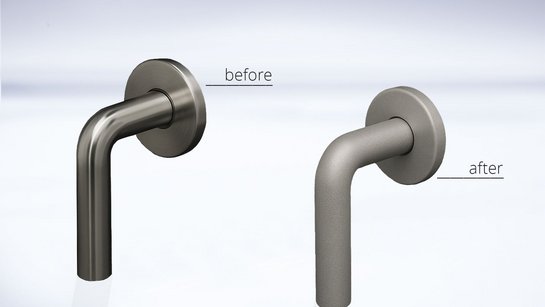
Sweeping, sweep blasting, or fine blasting is a particularly gentle method of roughening and is used especially for processing sensitive materials like aluminum, stainless steel, or hot-dip galvanized steel. These materials must also be gently cleaned and minimally roughened before coating, bonding, welding, or applying powder coatings. The use of angular blasting media and low energy (compressed air or wheel blasting) ensures that the base material or galvanization is not damaged and that the special properties of the surface are preserved.
Sweeping, sweep blasting, or fine blasting is a particularly gentle method of roughening and is used especially for processing sensitive materials like aluminum, stainless steel, or hot-dip galvanized steel. These materials must also be gently cleaned and minimally roughened before coating, bonding, welding, or applying powder coatings. The use of angular blasting media and low energy (compressed air or wheel blasting) ensures that the base material or galvanization is not damaged and that the special properties of the surface are preserved.
What is matting or decorative blasting
In industrial practice, metal and plastic surfaces are roughened to provide a better foundation for further processing. Irregularities are removed to create the best conditions for optimal interlocking or bonding of the surface and composite material (paint, adhesive). Proper preparation of the workpiece through cleaning and residue removal is crucial.
In industrial practice, metal and plastic surfaces are roughened to provide a better foundation for further processing. Irregularities are removed to create the best conditions for optimal interlocking or bonding of the surface and composite material (paint, adhesive). Proper preparation of the workpiece through cleaning and residue removal is crucial.
Optimal surface Preparation: What Role Does Roughening Play in Industrial Practice?

In industrial practice, metal and plastic surfaces are roughened to provide a better foundation for further processing. Irregularities are removed to create the best conditions for optimal interlocking or bonding of the surface and composite material (paint, adhesive). Proper preparation of the workpiece through cleaning and residue removal is crucial.
In industrial practice, metal and plastic surfaces are roughened to provide a better foundation for further processing. Irregularities are removed to create the best conditions for optimal interlocking or bonding of the surface and composite material (paint, adhesive). Proper preparation of the workpiece through cleaning and residue removal is crucial.
What measuring parameters describe surface roughness?
- Ra value (arithmetic mean roughness): Describes the average distance of all measured points from a mean reference line. The value is given in micrometers (µm).
- Rz value (average roughness depth): Indicates the average height difference between the highest peaks and the deepest valleys over several individual measuring sections.
- Rt / Rmax (total roughness or maximum roughness depth): Refers to the greatest vertical difference between the highest peak and the deepest valley within the entire measuring section.
- Rpk value (reduced peak height): Refers to the average height of the load-bearing surface peaks above the core profile and indicates how much the top roughness peaks protrude from the material core.
Bonding, painting, coating: Which roughness values ensure the most stable connection between metal and plastic components?

The Rz value is particularly suitable for this purpose, as it represents the average of the measured roughness depths, including the highest peaks and deepest valleys. Depending on the chosen process, material, and subsequent stress, the appropriate Rz value must be determined. In practice, this can range from 10 to 100 µm, depending on the required adhesion.
How does surface energy change through roughening?
Surface energy refers to the energetic tension at the interface of a material. It indicates how strongly the molecules on the surface are bonded. Any surface treatment process (such as grinding, blasting, or welding) alters the surface energy. Roughening a surface increases its surface energy and thus its adhesive capacity.
Which blasting media are suitable for shot blasting?

Corundum, garnet sand, ceramic, stainless steel grit, plastic granules, glass beads, or crushed glass beads. The selection — as well as the appropriate grain size — depends on the material to be processed, the processing goal or desired roughness value, the initial condition of the surface, and the sensitivity of the workpiece. Generally, angular blasting media are more suitable.
What requirements are placed on blasting systems?

Due to the use of particularly aggressive blasting media in shot blasting or roughening, the systems are subjected to high wear and must therefore be constructed to be correspondingly robust. The same applies to turbines and blasting drives, which are heavily stressed by continuous contact with the blasting media and would need to be replaced quickly without a suitable system design.
Use the Solution Finder to find the right system for your processing method.