

Removing Scale: Efficient processes for steel and iron surfaces
Oxygen and heat cause scale to form
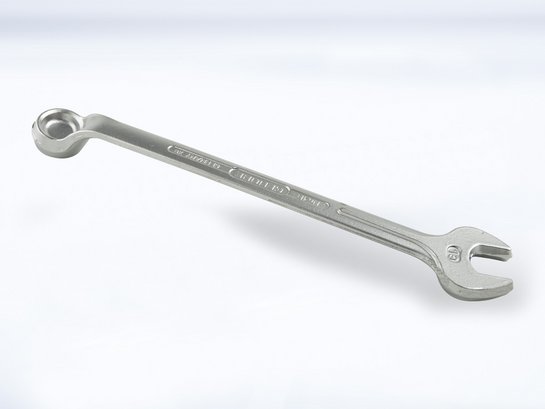
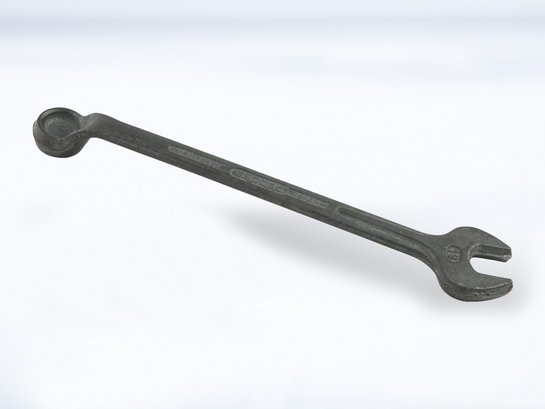

When steel or iron is heated, scale forms through contact with oxygen. This oxide layer must be removed to ensure effective further processing of the product.
Scale forms mainly during forming processes such as hot rolling or forging in the blast furnace, but also during heat treatment processes intended to improve the durability of metal / steel surfaces.
To avoid surface defects during subsequent processing (painting / mechanical machining), all scale must be removed beforehand. To achieve this level of surface cleanliness and surface quality, mechanical descaling, chemical descaling, and electrochemical methods (electrochemical descaling) are available.
A special form is weld scale, which is a by-product of welding. This must also be completely removed before any coating.
Descaling processes: mechanical and chemical methods
Descaling by shot blasting: Special requirements for the equipment
Scale can be removed particularly effectively by shot blasting using wheel blast or turbine blast systems. Since oxide scales typically have high hardness, they require strong impact energy of individual steel shot particles to obtain a clean metal surface after blasting.
In large rolling mills, steel plates, stainless steels, or raw steel are often descaled directly after production using shot blasting equipment and then provided with corrosion protection. These metal parts are then delivered to end customers. Beyond rolling mills, typical users include the steel production sector, forging operations, or heat-treating facilities.
Depending on the classification, scale adheres with varying strength to different materials. Dry scale — which forms on carbon steels — can be removed relatively easily. To remove adhesive scale, which forms a thin, closed, and very strongly bonded surface layer, shot blasting must be performed for a long time and at very high abrasive velocities. This residue also places high demands on the blasting equipment. If blasted-off scale enters the abrasive cycle, it acts like sandpaper. This leads to extreme wear of turbine blades and (in the worst case) can damage the components. Therefore, shot blasting systems for descaling must feature extremely reliable abrasive cleaning with effective air-wash separation.
A special form of descaling is wet blasting for stainless steel components, known as "Pure Finish." This process is particularly used to prepare surfaces for the food industry where high surface cleanliness and corrosion resistance are required.
Descaling by mass finishing (vibratory finishing): The most efficient option for small and medium-sized parts in large quantities
Beyond large rolling mills and foundries with massive workpieces, mass finishing can also be the first choice for removing scale from raw steel. Workpieces after heat treatment — especially in larger quantities — can be descaled or simply cleaned of discoloration (oxides) very economically in mass finishing equipment.
These finishing processes are especially suitable when surface impurities (oxides, oxide layers, contamination) do not adhere too strongly to the metal surface. Another advantage of mass finishing is the possibility of fully automated, program-controlled multi-step processing.
In specially modified mass finishing systems, parts can be cleaned, descaled, and polished in a single run. Deburring, grinding, smoothing, and polishing can also be combined as required. In many industrial applications, even part-to-part processing without media is highly effective. Cleaning and pickling inside tubular or sleeve-shaped internal geometries is also possible.
Another important consideration is the desired surface finish: Mass finishing can achieve relatively smooth surfaces, while shot blasting typically produces a rough but very uniform surface structure. It is also crucial how well the system integrates into the production line and how the workpiece is to be processed after descaling, for example through subsequent coating or additional finishing processes.
Chemical and electrochemical descaling
In addition to mechanical descaling methods — which include shot blasting, mass finishing, manual descaling (often using ceramic flap tools), and processing in a scale washer — chemical methods are also available. In chemical descaling, usually by pickling, the component is immersed in a bath where the scale layer is dissolved using acidic solutions such as hydrochloric or sulfuric acid.
The acid reacts with the iron oxides and removes the hard, brittle oxide scales from the metal surface. This chemical process can be intensified by applying electrical current.
This type of scale removal is particularly effective for complex geometries and hard-to-reach areas. A disadvantage is that acid residues must be thoroughly removed to prevent corrosion. The process also generates harmful fumes and wastewater that is environmentally damaging, and improper treatment can attack the base material.
What you should know about descaling:
Frequently asked questions
What is scale and how does it form?
Chemically, scale is an oxide or mixture of oxides that forms on the surface of iron or steel when the metal reacts with oxygen at high temperatures. It consists mainly of a mixture of various iron oxides, including wüstite (FeO), magnetite (Fe₃O₄), and hematite (Fe₂O₃). These oxide layers form at high temperatures, adhere strongly to the metal surface, and create a dense, hard outer layer that is difficult to remove using mechanical methods.
What is the difference between scale and rust?
Scale and rust are both oxidation products of iron, but they differ significantly in formation and properties. Rust forms at normal temperatures in the presence of water and oxygen. Scale forms mainly at high temperatures — usually without the presence of water. Scale adheres tightly to the metal surface and forms a dense, hard layer, while rust forms loosely on the surface, makes the material porous, and continuously promotes corrosion.
What is the difference between scale and burn-off?
Scale refers to the oxide layer that forms on the metal surface at high temperatures, while burn-off refers to the material loss caused by oxidation, burning, or slag formation. In steel manufacturing, such losses can reach up to 4% of the initial weight. Depending on the formation process, scale may also be referred to as mill scale, forging scale, or scale from heat treatment.
Use the Solution Finder to find the right system for your processing method.